Free Shipping on orders of $99+ click for details

Ask the experts: 260.587.9501 | Customer Service

Call Us: 260.587.9501 | Customer Service

Your cart is currently empty.
Free Shipping on orders $59+ click for details
Welcome to the 3Rivers Archery Trophy Room

Trophy Room

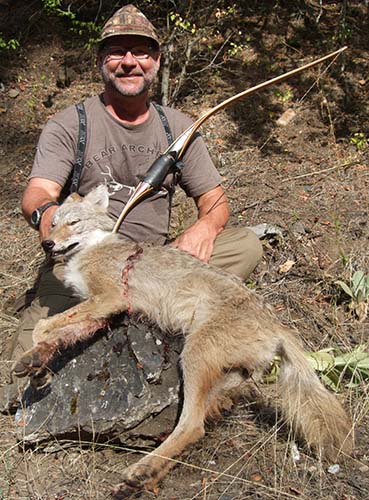
Welcome to the 3Rivers Archery trophy room. Browse successful kills with traditional bows from all around the world. Be sure to submit one of your own.

All posts by 3Rivers Archery

Your longbow and recurve experts. Serving the archery community as the World's largest supplier of traditional and primitive archery supplies.

Product Demos: How-To Videos from 3Rivers Archery 11

Product Demos/How-To Videos from 3Rivers Archery


Little Chopper Feather Die Cutter

3Rivers Archery has purchased the exclusive rights to the legendary Little Chopper! Enjoy this informative video about the use of this versatile and quality feather chopper.


The Arrow Whiz!

This tutorial takes you step-by-step through our new online tool, the Arrow Whiz. The Arrow Whiz allows you to design your own arrows, choosing material, fletching, cap wraps, inserts, points, broadheads, nocks, and more. You can build your own custom arrows online and have them shipped right to your door. It’s simple! It’s fast! And it’s FUN!


Setting Up a Youth Bow

Johnathan Karch of 3Rivers Archery shows you how to set up your youth bow. A great resource for parents who’ve just purchased one of our take down youth bows as a gift. As always, if you have any questions, give our tech line a call at 866-587-9501. The bow used in this demonstration is the Mohegan Take Down Recurve.


Tru-Center Taper Tool V2

Johnathan Karch of 3Rivers Archery demonstrates the new, improved, easy-to-use Tru-Center Taper Tool V2!


Byron Ferguson GoldTip Heavy Hunter Arrows

The legendary Byron Ferguson demonstrates the power and performance of his new GoldTip Heavy Hunter Arrows! Now available at 3RiversArchery.com.


Sound of the String Trailer

Brad Isham writes a truly compelling novel about bow hunting in Africa. 3Rivers Archery is proud to offer this critically acclaimed novel.


Cartel Aluminum Arrow Straightener

Johnathan Karch of 3Rivers Archery demonstrates how to use the Cartel Aluminum Arrow Straightener. This tool is a great way to extend the life of your aluminum arrows. Takes out bends and makes your arrows straight and true once again! Buy it today at 3RiversArchery.com, item #5902.


2012 3Rivers Archery Commercial

3Rivers Archery presents our 2012 commercial. You’ll see this commercial on several outdoor shows on various networks.


Byron Ferguson Heavy Hunter Arrows Demonstration

Byron Ferguson demonstrates the accuracy and penetration of his GoldTip Heavy Hunter Arrows. Great slow-motion shots! GoldTip Heavy Hunter Shafts, Item 6700X at 3RiversArchery.com!


Papa Strut Decoy Demonstration

3Rivers Archery is proud to offer Montana Decoys, including the Papa Strut! The Papa Strut features patented technology that allows you to quickly and quietly break down the decoy into two pieces, connected by four strong magnets. The decoy weighs about the same as a bottle of water and fits easily into any turkey vest, making it the most portable and packable 3D full strut decoy available. You can order the Papa Strut and other Montana Decoys at 3RiversArchery.com, item #6910X.


Fred Eichler Easton Bowhunting TV, 3Rivers Archery visit

This past fall, Fred Eichler of Easton Bowhunting TV visited 3Rivers Archery to meet the employees and tour the warehouse. Fred also found time for some Indiana whitetail hunting with 3Rivers Archery President, Dale Karch. Be sure to tune in this season to Easton Bowhunting TV for all the Eichler action! The show will air Friday May 3rd at 10:00 p.m. ET on The Sportsman Channel!


Adding Weight to Arrows

Johnathan Karch of 3Rivers Archery discusses various options for increasing your FOC (Front of Center) weight on your carbon and wood arrows.

Setting up a Bow Fishing Arrow

by Johnathan Karch

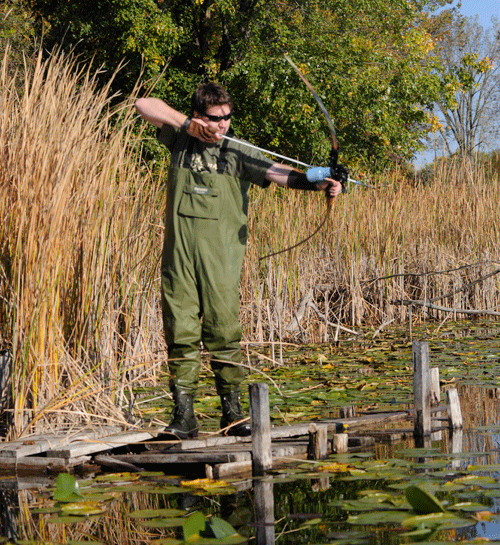
Johnathan Karch on the water with his bowfishing set-up
Bowfishing Can Be Fun and Rewarding

Bow fishing is fun for all ages. It is a sport that can be enjoyed by the beginner looking for more of a challenge than targets (and more fun) to shoot, to the die-hard bowhunter that loves to have the bow in their hands all-year round. Using the same bow as for shooting targets or bow hunting, an archer can be set up for bow fishing in quick order.

The bowfishing reel and arrow are the only gear requirements (however, many states/provinces require a fishing license, check your local regulations) needed to get you on the water chasing fish. Each of these pieces of gear requires a bit of focus. For now we’ll be covering the bowfishing arrow.

The majority of my bowfishing experience has been shooting carp on rivers. They are an invasive species and as a bottom feeder they won’t bite on a lure; making them the perfect target for a bowfisher. Easy to spot in the water due to their large size, you will be surprised how enjoyable sinking an arrow in one can be.

Building a fish arrow for carp is great for the beginner. I find it a great starting point as carp are found in most places in the United States and the same fish arrow can be applied to other bowfishing game.

Bowfishing Arrow Shaft

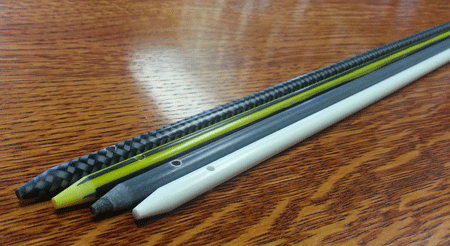
The backbone of your bowfishing arrow is the shaftThe backbone of any arrow is the shaft. The first thing you will notice about a bow fishing arrow is how heavy it is. This is due to the material used for the arrow must be extremely durable for taking hard hits, and the arrow must have great penetration to punch through scales on tough fish.

Most bowfishing arrows are made of fiberglass, carbon, or a hybrid combination of the two. Fiberglass is tough and less expensive, but nothing is as tough, nor offers the stiffer spine or straightness as carbon. The hybrid models of bowfishing arrow shafts inlay strips of carbon on/in the fiberglass to add the advantages of carbon (strength, stiffness, and straightness) without having the cost of a solid carbon arrow.

Most people leave a fish arrow full length, and do not cut it shorter to match their draw length like you would with other arrows. Bowfishing arrows are extra stiff, and the extra length helps weaken the spine so it is better tuned for your bow. The extra length also adds more weight to the finished arrow for heavier hitting power.

Bowfishing Points

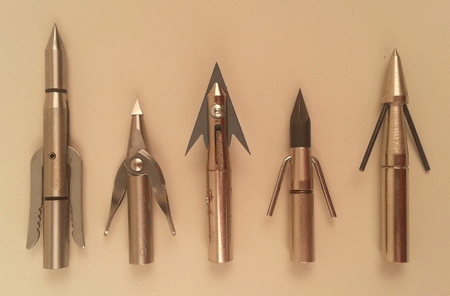
Match your bowfishing point to the fish and location
The point is the most important part of your bowfishing arrow set-up. Matching a bowfishing point to the fish you are after and your location can make or break your day on the water. Going after big carp on rivers/creeks is way different than gar on a calm lake. For carp, holding power and hard hitting penetration tend to be the most important. I also like a point that can reverse the barbs without having to touch it, as with bigger fish it is hard to push the arrow all the way through the fish to get at the point. For small gar in deeper in water, being able to get your arrow to the fish without water planning is important. Having a replaceable tip is an arrow saver if you bow fish in rocky areas.

On many bowfishing points there is a small hole at the base of the ferrule. This is so you can reinforce the point by installing a steel pin or nail through the shaft. Not a necessity, but if you are worried about hitting a lot of rocky surfaces, this is great insurance to not lose your point. It is recommended to use a drill press to drill the shaft for accuracy and safety.

If you’re not sure which point would work best, or if you do a lot of different types of bowfishing, checkout RPM Bowfishing points. Their APS (All Point System) uses a universal ferrule that all of their point bodies mount to easily so you can find the perfect fit for your shooting.

Putting it all Together

For building a bowfishing arrow, you need the same components as with a target or hunting arrow (except the fletching):
1) Point 2) Shaft, and 3) Nock.

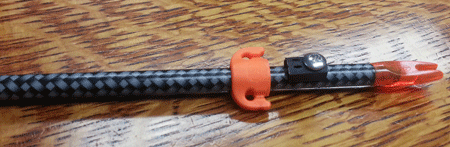
The AMS safety slide system installed on a fish arrowThe only addition for a fishing arrow is a safety slide system. Some may say this is not a requirement, but in my opinion safety is always #1. The AMS Safety Slide system keeps the bowfishing line in front of the bow to prevent the line from tangling with the bow string and having the arrow snap-back to potentially hurt (or kill) you and those around you.

For the first step you need to choose a fish shaft for the arrow. I prefer a carbon/fiberglass hybrid like the Cajun Yellow Jacket or RPM Hazard (shown here). I glue the nock in place first so the safety slide is aligned properly. For gluing the nock on I use a fletching glue such as Fletch-Tite Platinum. It dries fast and has good holding strength. I glue the nock so the pre-drilled hole at the back of the shaft is even with the notch of the nock (so the safety slide stop will be on top of the shaft).

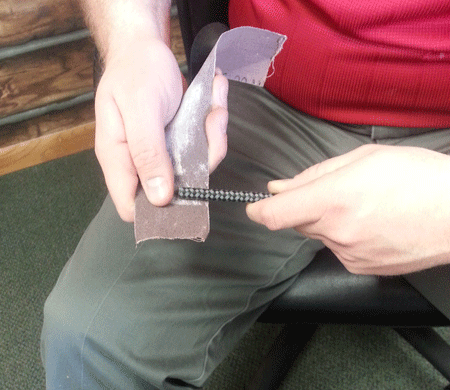
Finally, for installing the bowfishing point I use some sandpaper to rough up the end of the arrow so the epoxy has something to grip to for an extra strong hold.
Next I install the safety slide and all its components as it is important to have the slide in place before installing the bowfishing point.

Finally, for installing the bowfishing point I use some sandpaper to rough up the end of the arrow so the epoxy has something to grip to for an extra strong hold. I recommend AAE 2-Part Epoxy for mounting bowfishing points as the slow 24 hour cure time retains elasticity, yet holds like iron. This is a very good combo for points that will be taking a lot of punishment. Alignment of the point has no bearing on how it will shoot, so go with whatever you prefer. I prefer horizontal, as the barbs are out of my view and gravity has an equal impact on the barbs (if they are movable, like with the AMS Mayhem or RPM NOS Point). As I said though, it will have zero impact on how the arrow shoots.

Straight Shooting
Johnathan Karch

For more information contact:

3Rivers Archery
PO Box 517
Ashley IN 46705

1-260-587-9501

[email protected]

Getting Ready for the Hunting Season

by: Dale Karch

Having the right gear makes all the difference!
Longbow & Recurve Hunting – A Rewarding Challenge

In order to get ready for the upcoming hunting season, there are a few more items that need to be addressed other than just sharpening your broadheads. Mind you, a sharp broadhead is very important! But we need to look at all of our equipment, so lets start with the bow.

How does the string look? I personally like to replace mine every year, then I use last year’s string as my backup. Be sure to install the new string before you start to practice in order to make sure it is stretched out properly.

Now take a look at the string silencers. Do they need to be replaced? What shape is your arrow rest in? Keeping a few spare parts handy for quick repairs is always a good idea.

This is also a good time to take an inventory of your arrows. Do you have enough for the entire season or will you be spending valuable hunting time looking for new “bullets?” In addition, if you make them now or order them now, you’ll beat the rush and save on “Next Day Air” shipping charges. Don’t procrastinate – call 3Rivers Archery today!

Practice is key for hunting preparation!

I like to shoot feathers. They’re quiet and forgiving when shooting off the shelf. Before season starts, I apply a coat of feather waterproofing to the fletching on all my arrows. Not because I intentionally hunt in the rain, but to protect them from sudden downpours. Once, while bowhunting for elk, we were in the backcountry a good 4-miles from camp when a sudden rainstorm broke open and dumped 1-2 inches of rain on us in less than thirty minutes. I was lucky to have my arrows waterproofed or the rest of my day would have been spent drying out feathers. Be prepared!

Next check out your quiver. Is the gripper in good shape? Does the hood foam need to be replaced? Maybe this is a good time to look at what’s new on the market. Each year manufacturers are improving bowhunting equipment. Take a peak and check out what’s new and exciting. The Internet is a great source of information. Technology can be a good thing, even for the modern traditional archer.

Dale is never without his trusty Tomahawk Longbow!

Now it’s time to look at what we wear. Boots need to be oiled and tried on to make sure they still fit. Plus you might recall some problems you had with them last year or want to try out something new. What better time to deal with it than now?

Do you have enough clothing? Again, they keep coming out with lighter, warmer and more durable clothing so make sure everything still fits and replace anything that is worn out or is too small. Just like our wives, we never have all we need when it comes to clothing. Hunting clothing that is!

Now, for the most important part of the pre-season preparations – PRACTICE!!!!!! I love to shoot year round, but when hunting season is only a few months away, I start to take this very serious. Trying to practice with the same excitement you experience while hunting is impossible, but we can come close.

Scheduling regular practice time is key.

I like to shoot in the morning before work and in the evening after work. In the morning I have my bow and arrows ready to shoot, but before I do this I take a good long fast walk for about 2 miles. This will work up a good sweat and your heart should be pounding. Sounds like hunting to me. This is when I pick up my bow and take a few shots, and I do want to emphasize a few shots. My normal routine is to shoot six times with only two arrows. One should be setup with a broadhead and the other one with a field point. Both are shot at different targets and at different distances. This causes me to judge distances and focus on my target. Why only six arrows at each target? Knowing I have only one shot LIKE HUNTING; I pay special attention to every shot and make sure it is my best. Shooting at animal targets helps with becoming accustomed to looking at animals not bales of straw. I also believe this helps out at the moment of truth.

Keeping your gear in top order will keep you on target for a great hunting season!

Try practicing with some of my ideas and see if this helps you with your hunting success this season. Keep your arrows straight and your broadheads sharp!

Keep Hunting
Dale Karch

For more information contact:

3Rivers Archery
PO Box 517
Ashley IN 46705

1-866-587-9501

[email protected]

Spiral Wrap Flu-Flu Fletching Instructions

By TrueFlight Feathers
The quick and easy way to make a very effective, low cost flu-flu arrow.

Ideal for aerial and close range targets!
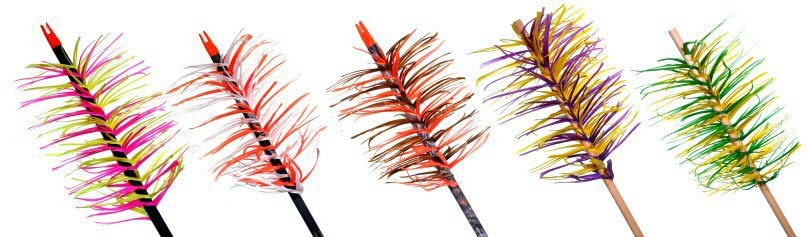
TrueFLight Spiral Wrap Flu Flu colors

CAUTION: ONLY TRUEFLIGHT SPECIALLY PREPARED FULL LENGTH FOR SPIRAL WRAP HAVE A SUPER THIN QUILL TO EASILY WRAP AROUND THE SHAFT. Regular full length will not wrap around the arrow shaft easily.

Step 1) Choose your colors!

The color combinations are almost unlimited. You can use a single TrueFlight Specially Prepared Full Length Feather per arrow, which will allow the arrow to fly further before slowing down, or you can use 2 or 3 feathers per arrow for shorter flights. Many fletchers choose 2 feathers for a nice color contrast. Left Wing feathers are used in this example.

It’s also recommended that you make a few “practice” fletchings on old arrow shafts or wood dowels just to get an idea of the final appearance and the best starting angles and spiral spacing.
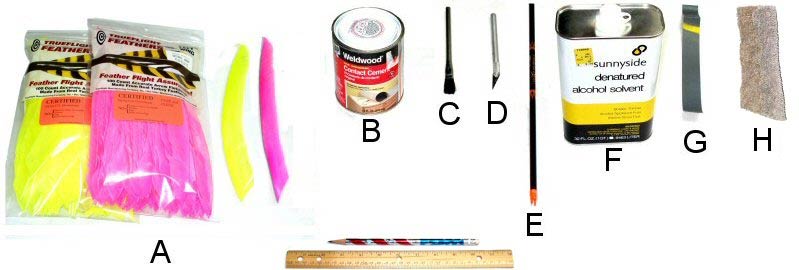
Supplies for building Spiral Wrap Flu Flu Arrows

Step 2) Gather materials and supplies

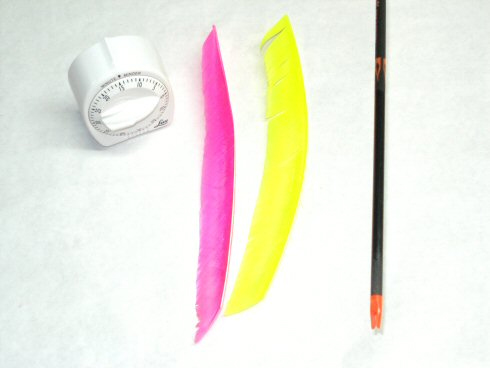
A = TRUEFLIGHT SPECIALLY PREPARED FULL LENGTH FOR SPIRAL WRAP FLU-FLUS. Regular full length will not wrap around the shaft easily. We’ll use two feathers in contrasting colors for this example.
B = Contact Cement.
C = Small Disposable Brush.
D = Small Knife or Single Edge Razor Blade.
E = Arrow Shaft. You can use Wood, Aluminum and Carbon shafts.
F = Denatured Alcohol.
G = 400 to 1000 Grit Sandpaper or fine steel wool or a “Scotch Brite” abrasive pad.
H = Clean rag or paper towel

(A pencil and ruler are optional)
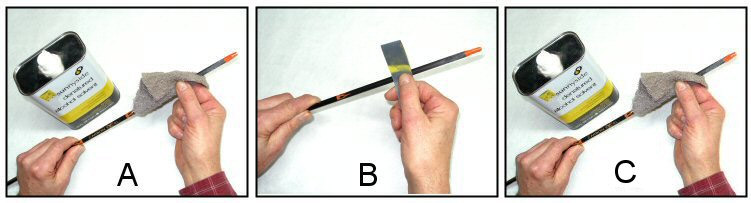
Preparing the Arrow Shaft for Fletching

Step 3) Prepare the arrow shaft

A = Clean the fletching area of the shaft by wiping with alcohol.

B = “Dull” the fletching area of the shaft by lightly sanding with 400+ grit sandpaper, fine steel wool, or a Scotch Brite abrasive pad. It is not necessary to remove the finish of the shaft. You just want to reduce the “gloss” so that the glue will adhere well.

C = Clean the fletching area of the shaft again with alcohol. Avoid touching this area again with your hands.
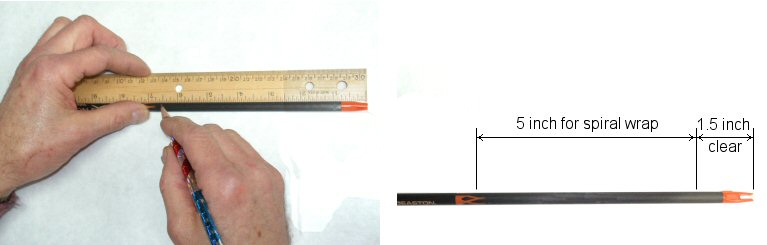
Marking positioning for Fletching Spiral Flu Flu

Step 4) Mark the approximate fletching position on the shaft

This step is optional. The position is not critical, and an “eyeball” estimate when applying the feathers is probably close enough.

It’s recommended that you leave about a 1.5 inch space from the tip of the nock to the end of the spiral wrapped feathers and do the wrapping along about a 5 inch length of shaft. You can vary these spacings depending on the appearance desired.
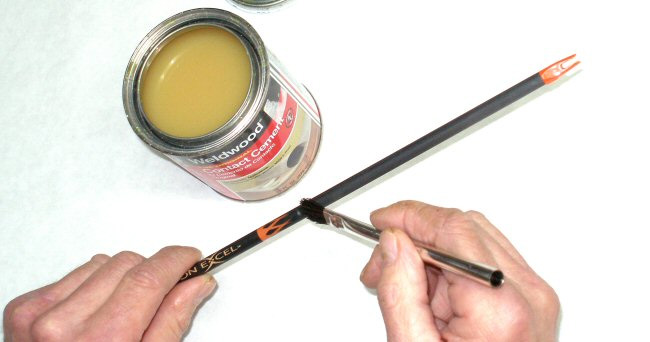
Apply contact cement to the fletching area

Step 5) Apply contact cement to the entire fletching area of the shaft

A thin, even coat works best. Remember you will need to attach the feather to the shaft within the next hour or so.
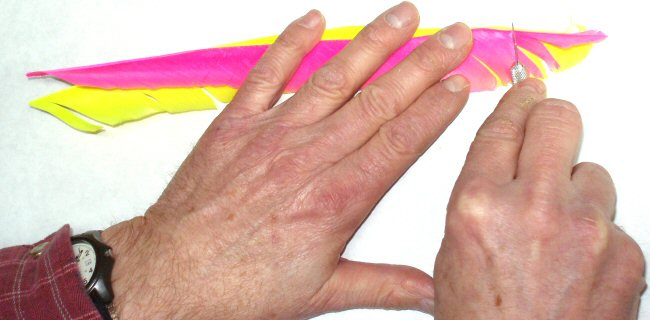
Trim the Tip of the feathers

Step 6) Trim the tips of the feathers to eliminate the “short” part of the web

It is not necessary for the two feathers to be exactly the same length.
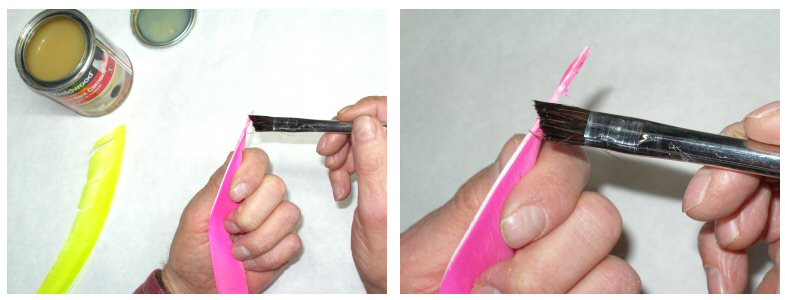
Applying contact cement to the feather

Step 7) Apply contact cement to the base of each feather

Grasp the feather by the web with the base upwards. The base is quite narrow. Use a thin layer of glue and take your time. It is easier with practice.
Wait 15-20 minutes before applying flu flu feather to shafting

Step 8) Wait 15 to 20 minutes

The glue should feel nearly dry before you apply the feather.

For best results, work in temperatures of at least 65F.

Of course you can use this time to prepare more shafts and feathers. By the time you have done 6 or so, the first arrow will be ready for assembly.
Press of feather to the arrow shaft

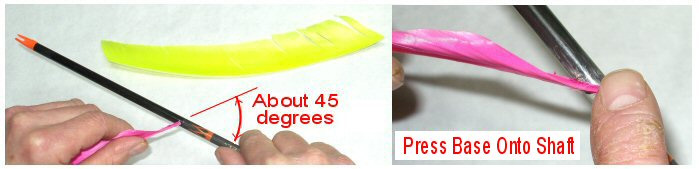
Step 9) Carefully press the end of the first feather onto the shaft.

Begin with the end of the feather with the widest web. The web “segments” should slope in the direction of the spiral.

Start with about a 45 degree angle to the shaft. Be sure to press the feather base onto a part of the shaft which has been coated with contact cement.

Once the two coated surfaces touch each other, they will stick instantly. Make sure the feather is properly positioned when it first touches — you will not be able to re-position it after it first touches.

After the coated surfaces have touched, press down on the end of the feather base to insure a permanent bond. The web of the feather can be pressed down on top of the base temporarily to apply force to the base against the shaft.
Wrapping of the flu flu feather around the arrow shaft

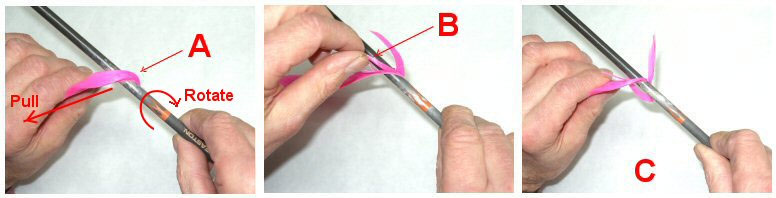
Step 10) Wrap the feather around the shaft

A = Keep a moderate amount of tension on the base pulling away from the shaft with one hand, while rotating the shaft with your other hand. For the first half of the turn, keep your finger pressing the end of the feather to the shaft as you pull the feather around.

B = If the web does not split and pop up from the base (as shown by the arrow in “A”), just nudge or pull the web apart as shown in “B.” The contact cement will hold the attached part of the web in place while you nudge the web.

C = Continue wrapping the web.
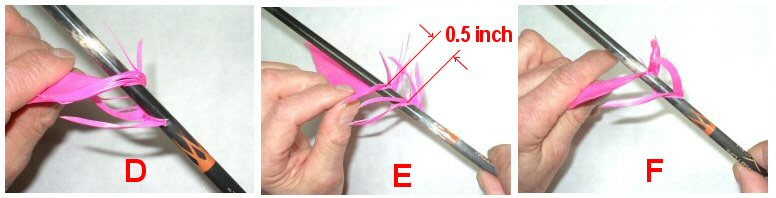
Mid way through wrapping a spiral flu flu arrow

D = Continue wrapping, and nudging the web apart as necessary.

E = It is recommended that you space the “turns” of the spiral about 1/2 inch apart. This can be made larger or smaller depending on the “artistic” effect you like. The exact spacing is not critical for arrow flight.

F = Keep up the good work!
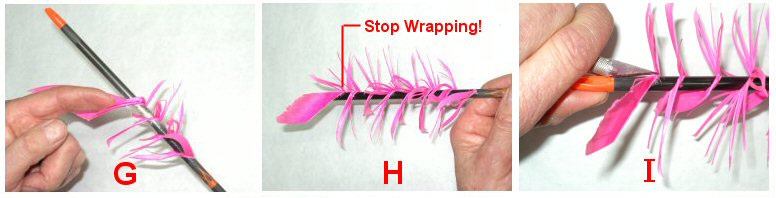
Final wrapping of a spiral wrap flu flu fletching

G = A little “nudge” is usually all it takes to encourage the web to split and pop up.

H = When you are near the end of the glued part of the shaft, STOP! If the feather is too short to make it all the way to the end of the glue, don’t worry — just press the end onto the shaft where it stops. A little shorter or longer spiral will make no noticeable difference in the flight of the arrow.

I = Cut the excess feather at the base. Re-press each end of the feather base. Discard the unused portion of the feather.
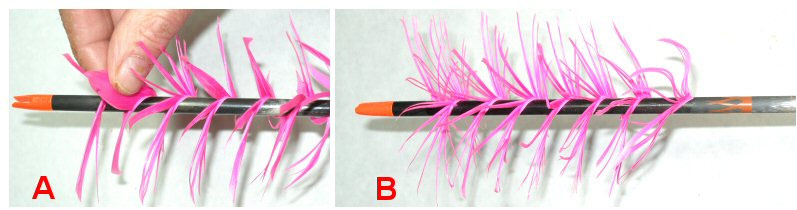
Final adjustment of fletching spiral wrap flu flu arrow

Step 11) “Nudge” any wide sections of web apart along the whole length of the spiral

A = You will end up with web “segments” about 1/16″ to 3/16″ wide, but this is not critical and some random variation makes for a more attractive arrow.

B = If you only want to use one feather per arrow — YOU’RE DONE! A single feather wrap like this will allow the arrow to fly somewhat further than a two feather spiral. But the arrow will fly just fine this way. It is hard to imagine a simpler or lower cost way to make a flu-flu arrow than this!
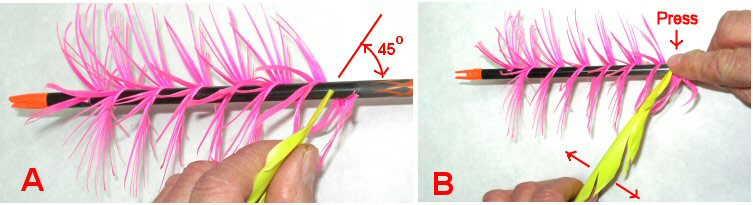
Wrapping the 2nd fletch on a sprial wrap flu flu arrow

Step 12) Wrap the second feather (optional)

A = Start the second feather in the space between wraps of the first. Once again, use about a 45 degree angle to the shaft.

B = Press the end of the feather base firmly onto the shaft. “Wiggle” the free end of the feather back and forth as shown by the arrows to fit it in between the web segments of the first feather.
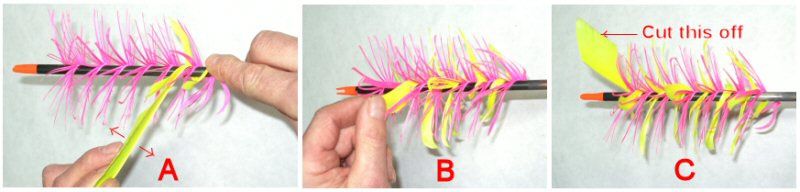
Continuing to wrap the 2nd spiral wrap flu flu feather

Step 13) Continue wrapping the second feather

A = Continue as done in the first feather.

B = Separate the web as necessary as before.

C = Stop wrapping before the end of the glued area of the shaft. Cut off the excess feather end.
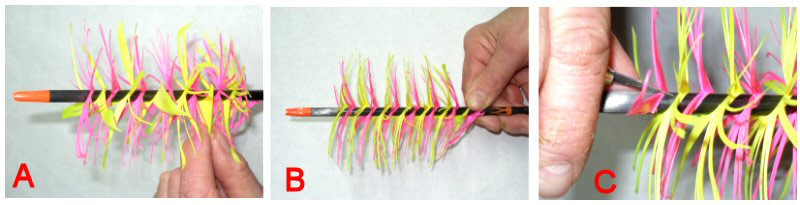
Finalizing the 2nd feather on a spiral flu flu arrow

Step 14) Finish up!

A = Once again, spread out web segments along the whole spiral.
B = Firmly re-press each feather end onto the shaft.
C = If a feather end does not want to stay down, just trim it off.
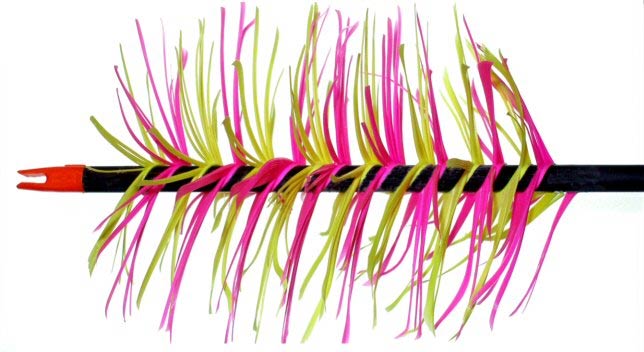
Spiral Wrap Flu Flu Arrow close up

Congratulations! You’ve made an attractive and very effective flu-flu arrow!

Helpful Hints and Special Effects
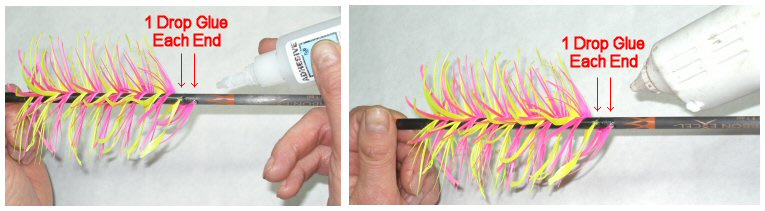
Add a drop of glue to the edges of your spiral wrap flu flu feathers

For extra security and unusually severe use, we simply add a drop of glue at each end of the feathers.

“Jell Type” super glue (or “Gap Filling” super glue) seems to work best. “Hot Melt” glue will also work, although you need to be careful not to use too much and leave a “bump.”

Ordinary fletching glue tends to soften the contact cement and is not recommended.

The content of this page was generously provided by TrueFlight Feathers.

For more information contact:

3Rivers Archery
PO Box 517
Ashley IN 46705

1-866-587-9501

[email protected]
or check us out on-line at 3RiversArchery.com

3Rivers DAS Bows Dalaa Testimonials

Chuck Ballweg and his new Dalaa recurve bow
Chuck Ballweg and his new Dalaa recurve bow.


“Got home and found my Dalaa at the doorstep. I couldn’t wait to try it out. Assembly was so simple and no tools but I had to install a T-300 rest, DAS plunger, nocking point, SRF Sight, Simms shorty stabilizer and started with brace height at 7¾” since new string.

Didn’t have much time to shoot before dark but shot the first arrow from 10 feet in front of bale and WOW. Absolutely no vibration or shock.

I started shooting with the same Axis 400 arrows that I was using on my Hoyt but they were showing a weak spine. I shot thru paper and confirmed they were definitely weak. I then switched to Axis 340 and they shot perfect thru paper. I fine tuned the nocking point and shot about 20 arrows before it got dark. Within a few arrows I was grouping just as tight as my Hoyt bow but with considerable less vibration.

I decided to check the poundage and was surprised that the Dalaa was 64# at my draw. Don’t get me wrong, I am not complaining, just surprised because it did not feel any heavier than the 60# Hoyt. I re-measured the brace height on the Dalaa and it had come down a little to 7 5/8″. I measure poundage with an Easton Digital scale so I think it is very close and I use a clicker to make sure my draw is the same every time. I put the Dalaa on my pulley board where I can crank it back and hold it at full draw to measure the draw length. Measuring from the string to the front of the bow my draw on the Dalaa is 30″. On the Hoyt measured the same way it is 29¼”. I am guessing the difference is due to the difference in the risers.

Now I just need to get out and shoot some more. Rain coming in this week so I might be getting wet but won’t matter, I have to shoot this bow. I already see I will have to learn all new gaps on the SRF sight.

My initial reaction; WOW!! I see what all the hype is about.”

Chuck Ballweg, CA


Henry Kulhawick and a group from his new Dalaa recurve bow
Henry Kulhawick and a group from his new Dalaa recurve bow.

“Just got mine Friday. I put a plunger, flipper rest, Doinker stabilizer and a regular single pin sight. And shoot with a release aid. This thing shoots like a Mathews. Smooth and accurate!”

Henry Kulhawick, Ohio


“My new Dalaa just arrived this weekend. In no time at all, I added a shorty plunger, SRF sight and flipper rest. NOW, I was ready shoot some arrows. I will share with you my thoughts on this bow.
Although some folks may prefer a more traditional look, the eye appeal was really high for me. The fit and finish was first rate. I like the camo pattern and the brown riser combination. The pre-silenced string was neat too.

Moreover, this bow really handles extremely well. My LH bow is 58 inches long, 55# @ 28″, but it seems to shoot faster than my other heavier bows. Stable in the hand and just plain fun to shoot. Now, it did take a bit of getting use, in adapting to the SRF site, but I was shooting decent groups quickly and even though I have never been a great GAP or instinctive shooter, I feel that this bow can really enhance my shooting skills going forward.

This bow has ALL the fine attributes that I was looking for…. ATTABOY for David Soza and 3Rivers!”

Barry Buckley, Arkansas


For more information contact:

3Rivers Archery
PO Box 517
Ashley IN 46705

1-260-587-9501

[email protected]
or check us out on-line at 3RiversArchery.com

Testimonials for Alex Gouthro Moose Madness DVD


M.R. James with Moose

M.R. James, Founder/Editor Emeritus of Bowhunter Magazine

Check out Alex Gouthro’s Moose Madness DVD Collection

Here is a Moose Madness Masterpiece

You gotta give credit to Alex Gouthro. When this guy sets out to create the most comprehensive video guide on moose hunting and calling ever produced, he does it right. Several years in the making, Gouthro’s Moose Madness Series DVD package is an A-to-Z action/information blockbuster that should be required viewing for anyone venturing into moose country.

In all, there are 4 DVDs and over 6 hours of video footage giving you everything you’ll ever need to know about North America’s largest member of the cervidae family: moose characteristics, subspecies and sizes, habitat, and a complete understanding of the moose rut. But once this general moose info is laid out, the focus shifts to specific calling techniques and tips, hunting setups, decoying, and numerous in-the-field encounters with rutting bulls. As a bonus, there’s a crash course in moose anatomy, shot placement, and field dressing complemented by expert advice on choosing effective firearms and bowhunting gear. A couple of actual calling/shooting sequences cap the action.

Speaking as someone who’s hunted moose with Alex Gouthro and seen this master Ontario caller, guide, and fellow bowhunter in action, I can attest to the fact he’s the real deal. In fact, 97% of the DVD footage was taped by Alex and his hunting buddies outside of federal or provincial parks in actual hunting areas during open seasons. Such realism adds an unmistakable air of authenticity and authority to Moose Madness. I give it an enthusiastic thumbs up!

Interested readers can obtain complete ordering information by going online and visiting www.gouthrosmoosemadness.com at Northwest Video Productions’ home page. To reach Alex directly, send emails to [email protected] or call (807) 767-0494. His own successful Northern Ontario Bowhunter Services offers quality hunts in prime Canada moose country.

M. R. James

M. R. James, Founder/Editor Emeritus of Bowhunter Magazine, is a living legend in bowhunting circles, and is still living his lifetime of bowhunting experiences. Leading by example, he has made vast contributions to the education of bowhunters through his writings – and through encouraging others to share their experiences in the written form. In fact, he encouraged Alex Gouthro to write his first article back in 1993.


Dana Brackins Bronson with Moose
Moose Hunter, Dana Brackins Bronson, Michigan

Alex, thank you for your years of hard work in the field and the hundreds of hours you must have spent in the editing room on the production of the Gouthro’s Moose Madness Series On Moose Hunting & Calling.

I have been hunting for over 30 years and have many, many times purchased so-called educational-type videos to try to learn all about the species that I am going to be hunting. In all those years I have never seen anything as comprehensive as the four- part DVD set making up the Gouthro’s Moose Madness Series. This is by far the most comprehensive set of educational hunting videos I have ever watched. Watching these videos was almost as good as spending years in the woods personally with you. I felt I was there — learning all the secrets of a professional moose hunting guide and caller.

I hunted moose for five years before taking my first bull. I truly believe that if I had your series of DVD’s before starting on my quest for a moose I would have been successful much, much earlier. I feel that if first-time hunters were to study the Moose Madness Series before going on their first moose hunt it would not only save them money but also allow them to better enjoy the hunt. I know without a doubt that it would increase their chances of success.

This set of DVD’s are not just for beginners; they are a ‘must have’ for both new and experienced moose hunters. I have watched them three times so far and am learning something new each and every time. The lessons learned from these DVD’s would be a bargain at twice the price.

Dana Brackins is a highly successful bowhunter and is presently the Pro Staff – Field Staff Director for Carbon Express Products, Eastman Outdoors, Inc.

Moose Hunter Rick Guyatt

Moose Hunter Rick Guyatt Oakville Ontario

Alex, thank you for taking a moment to speak with me following your seminar on Friday March 17th at the Toronto Sportsman Show. You may recall we discussed the increasing moose mortality related to heat and global warming.

First let me congratulate you on a significant achievement. Even those not particularly interested in hunting will find the live footage of moose in the wild startling and fascinating. Up close and personal is probably the best way to describe this magnificence footage.

Your DVD Series is the most comprehensive I have found in 10 years of research and reading on the subject of moose and moose hunting. I have collected many videos on moose hunting; however, I particularly liked your overall approach to the subject and the manner in which you formatted the content. Your video series covers the subject of moose hunting from start to finish.

The content is presented in a logical sequence and chaptered for quick reference to specific subject areas. This makes the series appropriate for both the novice and the experienced moose hunter.

As to the moose anatomy and shot placement portion of the series, I was particularly pleased with the overlays and red dot marks on live footage of real animals in their natural habitat. This gives the viewer a truer sense of how it feels to locate the aiming spot, but even more importantly it communicates a sense of timing the shot and the short window of time to hit the spot if the animal is moving. Yours is the first presentation I have found which deals at length with the frontal shot.

Thank you again for your significant contribution to the field of moose hunting.

Arrow Tips by Gold Tip: Bare Shaft Tuning

Gold Tip logo

Arrow Assembly
Broadhead Tuning
Paper Tuning
Bare Shaft Tuning

Bare Shaft Tuning

Gold Tip recommends bare shaft tuning for any setup shot with a finger release. In order to use this method you will need two fletched arrows and two bare shafts. Follow the illustrations below  to fine tune your setup.

This diagram depicts optimal tuning for the bare shaft tuning method. Bare shafts and fletched arrows should have very similar impact points.


Stiff Arrow when bare shaft tuningStiff Arrow

    Possible Corrections:

  • Use a longer shaft
  • Use a lighter spined shaft
  • Add weight to the insert using Gold Tip weight system, or by adding a heavier weight point

Weak Arrow when bare shaft tuningWeak Arrow

    Possible Corrections:

  • Cut shafts shorter 1/4″ at a time
  • Use a stiffer spined arrow
  • Decrease point weight
  • Add weight to the rear of the shaft


Low Nock Point when bare shaft tuningLow Nock Point

    Possible Corrections:

  • Move nock point up
  • Move arrow rest down


High Nock Point when bare shaft tuningHigh Nock Point

    Possible Corrections:

  • Move nock point down
  • Move arrow rest up

SRF Sight System Buyer’s Guide

SRF Sight System

Theory and use of the SRF sight:
This sight uses the eyes natural ability to center objects much as a round aperture does. Unlike a round aperture though, this shaped aperture allows you to memorize target positions along the tapered shape. The sight must be used until that memorization occurs and becomes natural. In that respect it is very similar to instinctive shooting. Once you reach that point, the sight becomes extremely fast and automatic to use. That is why there are no marks on the sight and no numbers. Adding marks defeats the function of the sight. Proper use of the sight makes it extremely deadly at unmarked yardages. With all other sights, you must go through the thought process of judging the distance. Then you must decide which pin to use. If the range falls between pins, you must decide where in between to hold. While you are figuring all this out, the deer is heading over a distant hill. It is one reason why shooting running game with most sights just does not work. With the SRF you are shooting with an instinctive sight picture, so the proper hold is instantaneous.

There are only two adjustments to make with the sight. The first is to align the center (the widest part) of the sight vertically with your reference range. Normally this will be around 20 to 25 yards for most people. Since there are no marks to calibrate, it does not matter if the range ends up being 21 or 24. All you are doing is setting it close to the middle range you shoot. The aperture chosen must be based on the ranges you intend to shoot. Those ranges must all be within the aperture. If your aperture has a long and short end, the long end goes down. The proper aperture will allow you to frame every target within your shooting range. The next adjustment is the right/left centering. Once this is done, no further adjustments are needed. Just take it out and shoot.

In the beginning you will have to think about where to hold the sight for different ranges. Remember, you have to learn to use this sight! I don’t even bother shooting at marked ranges. I just judge the range, hold the sight where it belongs, and let go. Your concentration should always be on the target, and the sight should be in your secondary vision. I suggest starting out shooting at a large bale target until you get a feel for using the sight at different ranges. Then practice with the sight by stump shooting, 3D, hunting, etc. As you get used to the sight, you will find that it will slip farther and farther into your peripheral vision and consciousness. When this happens you have arrived!

A word about anchor point:
For all types of barebow shooting the arrow is the primary alignment tool. To shoot effectively the arrow should be directly under the eye. The fact is though, that for many that is very difficult to do because of facial structure. I believe that has been a limiting factor in my shooting. Using the SRF sight, the arrow plays no part in the aiming process, so that allows you to utilize a more natural anchor and adjust the sight accordingly. This has improved my alignment, back tension, and consistency.

Troubleshooting:
1. Shots seem inconsistent: Most often this is caused by looking at the sight rather than concentrating on the target. The SRF is actually not a sight in the usual sense, It is a reference frame, much like the arrow provides a reference. For it to work you have to trust it, and give it time.

2. Tend to release before the proper sight picture is attained: My technique for using the sight is to draw with the sight over the target. As I reach full draw, I slowly lower the sight over the target and acquire the picture and release. It all happens very quickly, but it is very controlled.

3. Arrows group, but not on the target: This could just be a matter of adjusting the sight. It could also be that you have discovered a flaw in your form. For Instance: If it seems fine, but then your shots start going low and right, you may be dropping your bow arm at release. There are many what-ifs here, but it most likely is not the fault of the sight.

Mounting Options:
One of the unique features of this sight is that it can be mounted either in a conventional slotted bracket or directly in the sight window above the arrow rest! This later choice requires that you know the proper placement, so you can drill the hole properly. The centershot of your bow may force the sight too far out, so that is another aspect that must be checked before drilling. Most people will do best with a bracket designed for this sight. The DAS Dalaa, and most other bows can use the universal mounting bracket listed on the sight page. The sight can be mounted on either the back or belly side of the bow.

Choosing the correct sight:
There are three questions you must answer to choose the proper sight profile and finish:

1. What ranges do I want to shoot with this sight?
Decide what range of distances you want to cover with the sight. Use a set of sight pins or some temporary sight set-up to find the pin settings needed for your minimum and maximum distances. A couple of sewing pins held with tape works well. Measure the distance between the pins.

If the distance is between 1/2" and 3/4", select the "A" profile

If the distance is between 13/16" and 1-1/8", select the "B" profile

If the distance is between 1-3/16" and 1-5/16", select the "C" profile

2. Will the sight work with my anchor?
Extremely high or low anchors may force the sight into the top or bottom of the sight window and lead to arrow interference or window interference. Once you have pins in place from your test, allow at least 1/8" to 3/16" more at top and bottom. If an interference occurs, you will have to change anchor point or choose a smaller, more range limited sight profile.

3. Do I need the Lume coating?

This is a more personal question, but the coating would be nice if you hunt under thick canopies or in the very early/late hours. If your night vision is good, chances are the all black sight is the best choice. If you have some trouble in low light, the lume coating will solve the problem nicely. Two instances though make the lume very nice. Shooting at dusk against a dark background, and walking out of the bright sun into deep shade. You can really pick that lume sight up fast then.

Back to Top