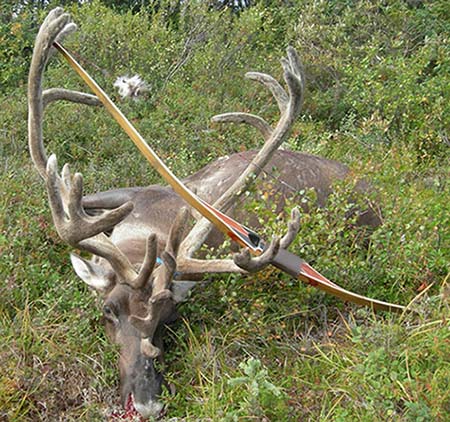
Welcome to the 3Rivers Archery trophy room. Browse successful kills with traditional bows from all around the world. Be sure to submit one of your own.
All posts by 3Rivers Archery
Your longbow and recurve experts. Serving the archery community as the World's largest supplier of traditional and primitive archery supplies.
Name: Brian Turner
Country Harvested: United States
State/Province: Pennsylvania
Year: 2017
Type of Game: Trophy Room, Whitetail Deer
Equipment Used:
1970 Bear Grizzly Recurve, Gold Tip Traditional 500, woodsman 125 grain broad head
Additional Info:
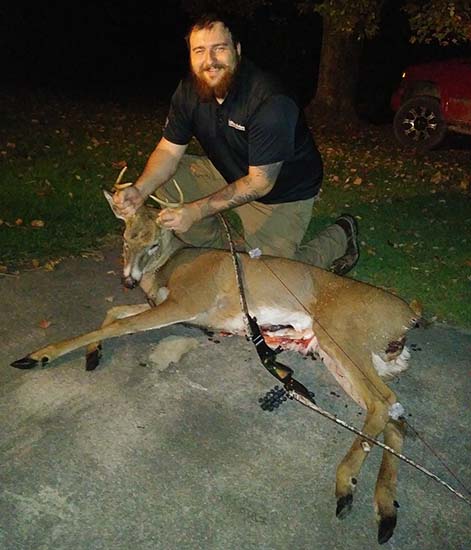
I just starting shooting traditional this April. My goal for the season was to harvest a deer with this bow I picked up at an antique store. 4 mins before I was gonna head in for the morning This 7 point buck walks out of the brush 15 yards away.. He looks up but doesn’t leave, lowers his head so I let the arrow fly. He went 70 yards with all 32″ of my arrow. So blessed to be able to harvest a deer using traditional equipment. I’m hooked!
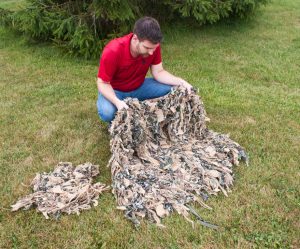
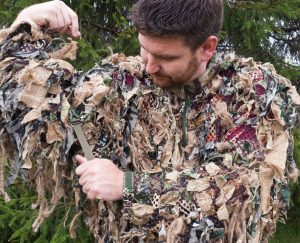
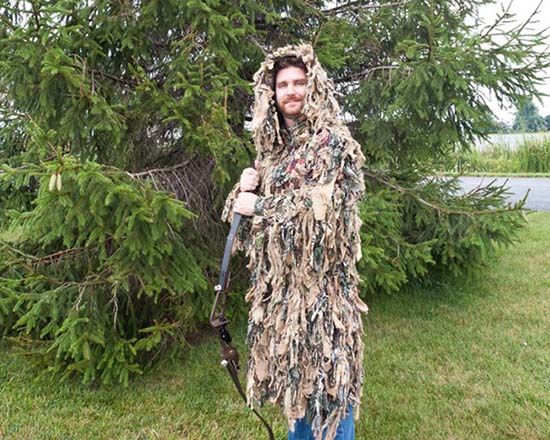
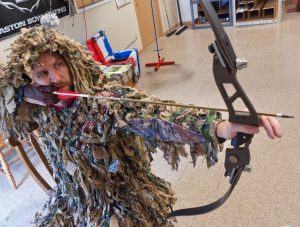
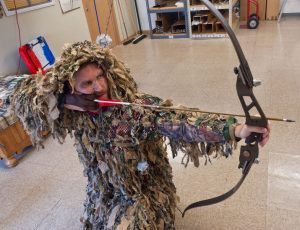
The ghillie suit is an excellent addition to the traditional bowhunter’s bag of tricks. The textured camouflage clothing of a ghillie suit is designed to break up your outline to help you blend into your environment. Ghillie suits are also called sniper suits as they are used by military sniper units all over the world.
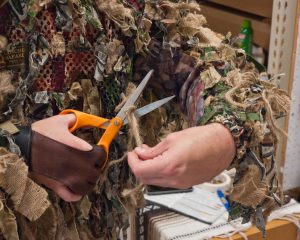
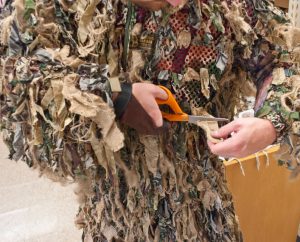
Wearing a ghillie when bowhunting can offer more opportunities to get you closer to big game and out of the treestand. The challenge for the traditional bowhunter is customizing the ghillie suit to not interfere when you are shooting your bow. Getting your ghillie suit ready for hunting season only requires time and a good pair of scissors. We are using the Rancho Safari Shaggie® longcoat. If you use a different brand of ghillie suit, it may require more trimming.
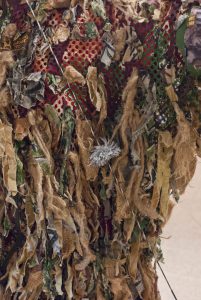
Ghillie suits are hot. Adding strips of material, such as jute burlap and cotton, helps to break up an outline, but it also reflects your body heat back on you. So when wearing a ghillie suit you have to take into consideration that it will not be comfortable to walk around in. Many hunters will carry them to where they intend to hunt, then put them on.
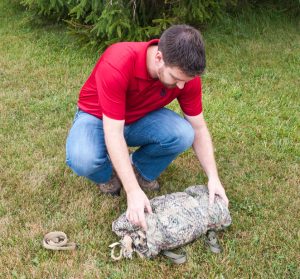
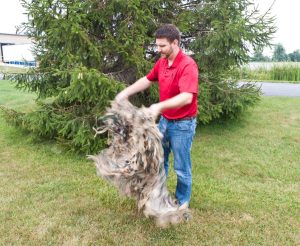
When you first get your ghillie it is best to open it up outside in case of any loose material. We recommend giving it a good shake into the wind to force anything not sewn down to come off.
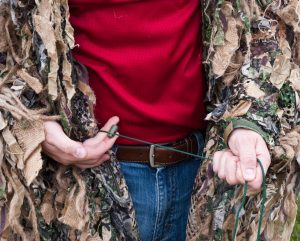
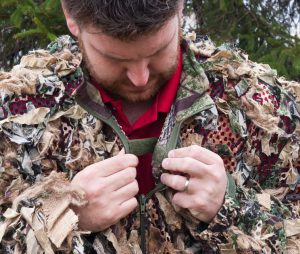
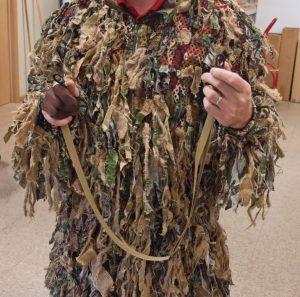
When first fitting a ghillie suit be aware of all straps, ties, and Velcro® strips. You want your suit to fit tight against you so as not to be cumbersome, get in the way when shooting, or get snagged on brush. The Shaggie longcoat has a waist level cinch cord, zippered front, forearm straps, and a Velcro® collar strip.
Now with the ghillie suit situated, do some walking around. Try some stretches, stalking (crouched slow walking), and just anything to confirm the ghillie fits properly to your body.
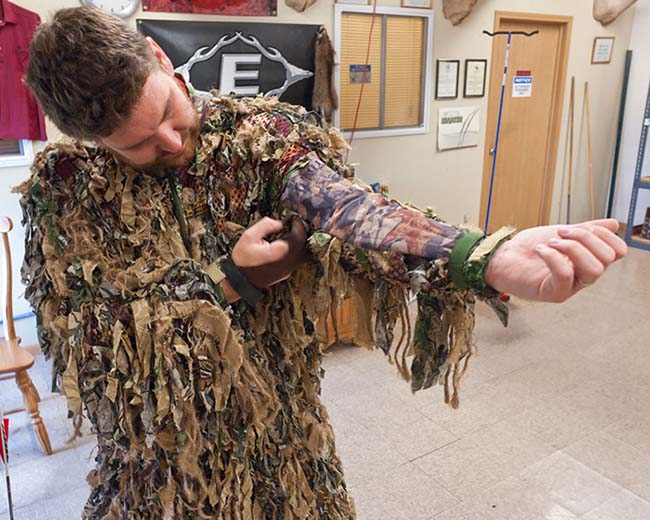
One great accessory to have is an extra long armguard. Rancho Safari offers the Cat-Guard Armguard and fits nicely on most arms and is made to bend with your arm for great comfort.
TECH TIP: When putting on your armguard, turn your arm so your palm faces up and the straps point downward. This will get more of the camo strips to the outside of your arm and away from the bow string.
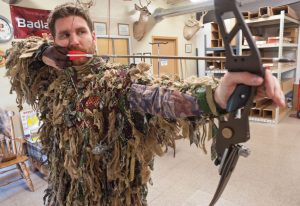
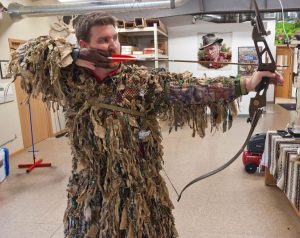
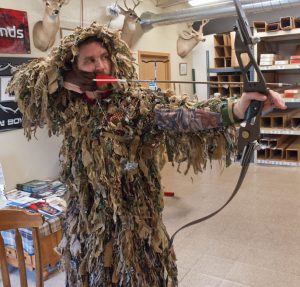
Now, it is time to practice shooting your bow and arrow with a ghillie suit on. This is best done with a friend to watch where the ghillie suit is interfering with the bow string. You can do this step alone, either by setting up a camera to record yourself, or by pulling to full draw and holding while inspecting. Pay close attention to your upper chest nearest to the bow. Depending upon your form, this is the area that will require the most trimming.
Using a pair of good scissors, trim down any strip that comes in contact with the bow string when at full draw. How much that will be cut is up to you, but you don’t want to miss the shot of a lifetime, or wound an animal, because your bow string got caught on a strand. This process can be quick, or it can take an hour(s). It really depends on how much the string is being interfered with and how many different shooting positions you are trimming for.
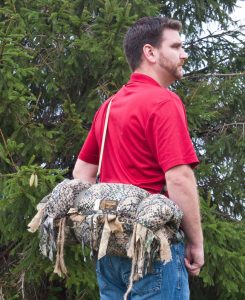
TECH TIP: Wear a chest guard, or the included carry strap, to cinch down material across your chest.
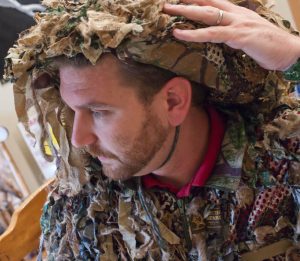
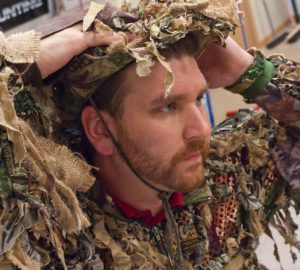
Most ghillie suits will include something for your head; a facemask and/or a hat. These help break up your outline, and may require trimming as well to make sure they do not interfere with your anchor.
The Shaggie longcoat comes with a boonie hat. It is best to trim all that you can in front of your face so as not to have any strands in your peripheral vision that may distract you during the shot.
TECH TIP: For the right handed shooter, put the straps of the boonie hat behind your LEFT ear and in front of your RIGHT ear. This will help keep the hat in place when you go to draw your bow.
With all of your trimming done it is time to practice, practice, practice. Shoot your bow with your ghillie suit on any chance you get. You want to be 100% comfortable shooting with it on by the time you are using it during a hunt. Be sure to shoot standing, sitting, kneeling, and any and all positions you can safely shoot a bow from. Always be willing to trim unneeded pieces to make sure your shot is not interfered with.
Bowhunting with a ghillie suit is an exciting undertaking. Once you get your ghillie suit fitted to your body and shooting style you will be on your way to an exciting new chapter in your hunting career. Best of luck, and be sure to share with us your hunting successes at our online trophy room here.
Teresa Williams, VP of Operations at 3Rivers Archery
Teresa Williams, VP of Operations at 3Rivers Archery, was elected to the ATA (Archery Trade Association) Board of Directors after winning a tie-breaking run-off election. This is the first tie in ATA Board of Directors’ history. Teresa will be taking her position on the ATA board starting April 1, 2017. Her term will last four years.
“I’m excited to represent 3Rivers Archery in such an esteemed role in the archery community and humbly welcome the opportunity. Archery has been my passion in life for the last 16 years, both professionally and personally, so I’m eager to help the industry empower future opportunities and protect our lifestyle.”
– Teresa Williams
Teresa has been with 3Rivers Archery for more than 15 years, her responsibilities focus on the overall health of 3Rivers Archery along with managing our data analytics.
As a member of the ATA Board of Directors, Teresa will focus on the growth and health of archery as a whole. Some areas she will work on are expanding archery to younger generations, conservation of the outdoors, helping archery businesses to stay competitive with online giants like Amazon, and having companies hold to fair pricing.
With Teresa’s expertise in leveraging analytics data, the entire archery industry will be better for it. As a member of the ATA board she looks forward to finding ways to grow the archery community so we can all continue to enjoy our great sport. Adding her expertise and background in traditional archery will be a big boost to the ATA board of directors.
All of us at 3Rivers Archery are excited for Teresa and what she has to offer in her new position on the board of directors. We look forward to seeing the growth she can add to the archery community over the next four years of her term on the board.
Learn Bowhunting Spring Turkey hunting tips from Denny Sturgis Jr.
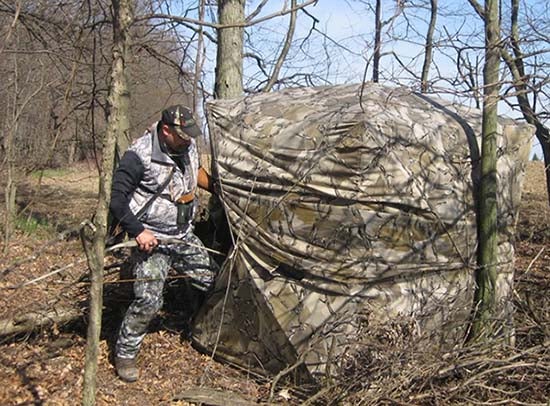
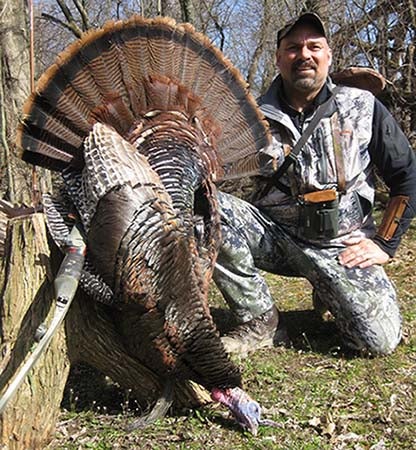
The point-blank, booming gobble shattered my peaceful daydreaming session while turkey hunting. My blind was positioned in a brushy fence row and I could only shoot straight ahead into the harvested bean field or directly behind into a long abandoned, fallow field sprouting trees. The gobble had sounded from straight down the fence row. I carefully cracked a closed shooting port just enough to peer down the fence row. Through the branches, I saw three hens scratching around walking my direction with a mature tom strutting behind. When the turkeys broke to the right, I dropped the black curtain on the front window of the Double Bull blind. After easing a back window open, I readied the longbow. The hens scratched on by with the gobbler still strutting along behind. The early morning sunlight made his feathers glow with an oily sheen. When the tom reached a clear shooting lane, he folded back to normal size. Concentrating on the area straight above his legs, I drew to anchor, aimed and pulled through to conclusion. The arrow flashed ten yards and neatly disappeared in the longbeard. He took several steps, sunk to his breast and flapped his wings twice. Quickly nocking another shaft, I watched intently for movement, but it was over. Unzipping the blind, I stepped out to examine my prize.
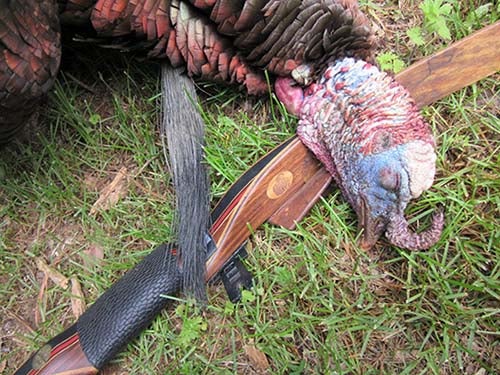
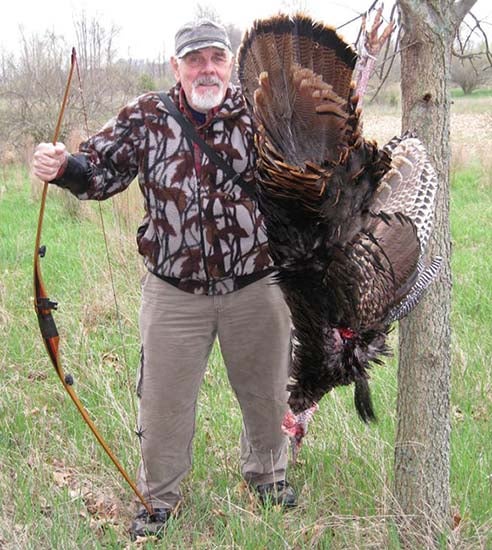
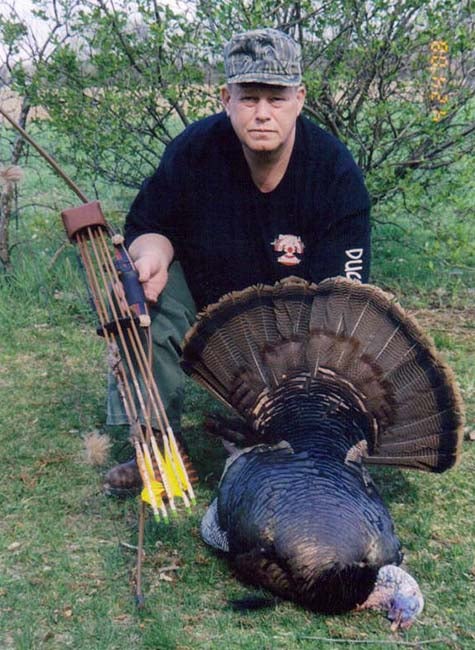
Denny Sturgis Jr. – The author – with the seventh mature tom taken from his deadly inside corner set-up. He used a Black Widow Osage longbow, Arrowmaster quiver and a Woodsman broadhead.
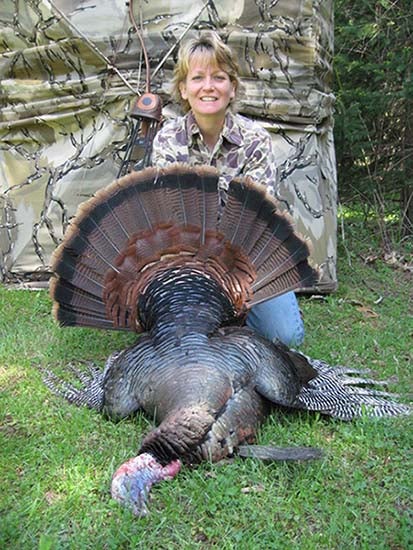
This was the seventh mature gobbler I’d taken turkey hunting in as many years from the same spot. To cap the season off, my wife, Marie, anchored her first tom from the same blind a week later. She called to a group of hens with a longbeard in tow. They crossed the field, but acted like they weren’t interested. When they disappeared into the fence row eighty yards away, Marie settled back into her stool to continue her vigil.
Several minutes later, she heard some rustling outside the blind. Looking up, she saw a hen walk by the shooting port at six yards. She said she nearly fell off her stool when a gobble erupted from just outside the blind. She eased her recurve into position as a big tom with a ten inch beard stepped into view at eight yards.
“I had to draw three times because I was so nervous I kept knocking the arrow off the shelf,” she exclaimed later.
The third draw was the charm though and she thumped the broadside bird mid body, right above the drum sticks. He ran forty yards into the field and tipped over.
The author’s wife, Marie, poses with her first turkey taken in the same blind a week later. She used a Black Widow SAIII, Carbon Express arrow, and a Grizzly broadhead.
In this post, I’d like to share some of the successful set-ups my friends and I used last year to collect our spring toms.
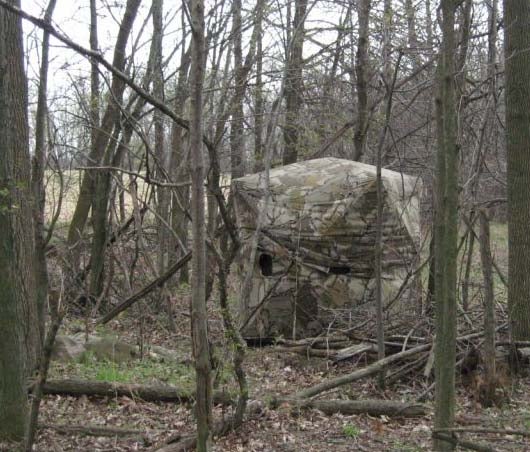
The turkey hunting location I wrote about in the opening is on the corner of a wooded fence row. The fence row starts from the middle of a twenty acre woodlot on one end and separates row crop fields. The other end connects to the outside corner of a smaller woodlot and the corner of a fallow field laced with brush, young trees and swatches of native grasses. Another fence row runs along the edge of the fallow field and joins the same corner of the smaller woodlot forming the ninety degree corner where the blind was set.
This is the blind set-up the author and his wife used to collect their birds
I’ve seen enough turkeys go through this area to have the confidence to sit all daywhen possible. In fact, three of the seven birds I’ve shot there were taken in the afternoon after work. The toms were making their way back to the larger woodlot where they like to roost. I set up away from the roosting area to keep the pressure off these birds. The surrounding are has intense turkey hunting pressure and I want to be able to turkey hunt all season if necessary.
I used to use decoys and while hens and jakes came in, the mature toms usually hung up fifty to eighty yards away. There is thick cover behind the blind, so I forgot about the decoys and tried to make the calls form my Primos, Power Crystal sound like they came from the dense brush. Immediately the calling paid off and turkeys came into close range looking for their pals in the thick stuff.
I think different tactics are necessary for different locations and states. What works in one area might not get any results in another.
End results of getting correct shot placement a bird.
One thing my buddies and I agree on is shot placement for body shots. We look at the turkey’s legs and shoot above them. If the shot is low you take out the drum sticks, which equals a dead bird. A high shot on a broadside tom usually drops them. Shooting to far forward on a broadside tom can be bad news. Their breast is large and has no vitals. I recovered a Tom I hit back on a broadside hit by waiting. I snuck along the trail four hours later and found the tom about eighty yards away. Head on or straight away shots are deadly with good line. I’ve never shot at a strutting Tom, but I have a buddy who says the rear port is a perfect aiming spot.
Blinds are another subject we agree on. Our favorites are the Double Bull Recurve Models. The Double Bull stools are comfortable also. I’ve shot some using the shoot through netting and some without.
The author’s father, Denny Sturgis, Sr. shot this tom with a longbow and a Zwickey Eskimo tipped Beman ICS Hunter carbon arrow.
My dad has a spot he’s taken three toms from. It is the inside corner of a woods bordered by a CRP field. He sets his blind on the edge of woods under a tree. An old logging road cuts though the woods and ends at the CRP in the same corner.
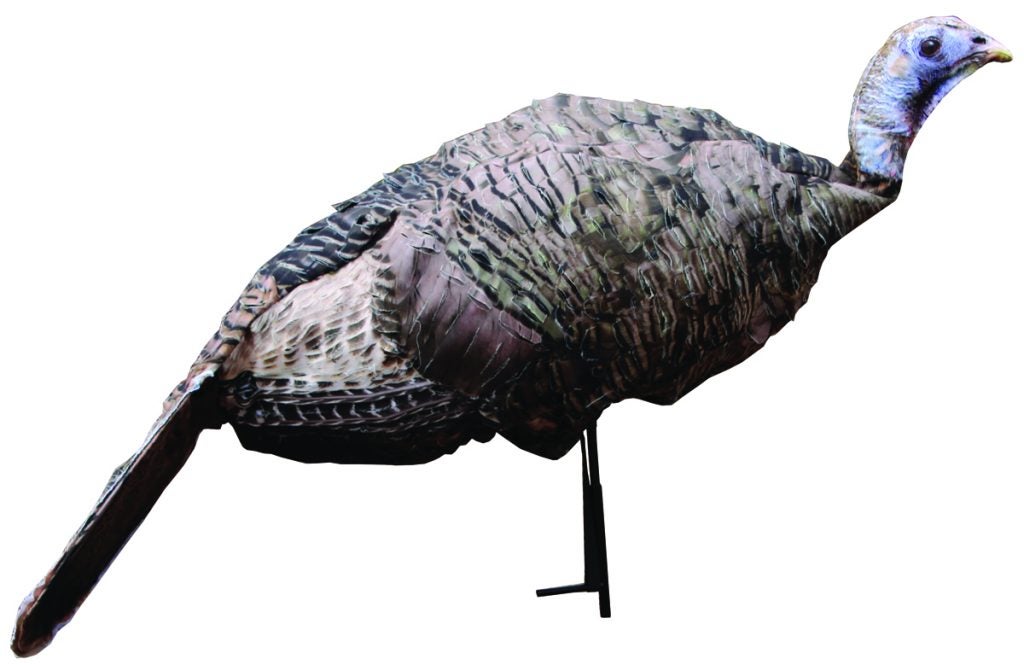
Montana Decoy Miss Purr-Fect Hen Turkey Decoy is a great decoy for bringing in stubborn toms.
Dad entered the blind in darkness after placing one hen decoy ten yards from his blind in the field. Some toms gobbled from the roost at daylight and flew down into the CRP field a little later. Dad saw one out in the grass and called to it with his Primos, Carbon Prospector. The bird walked in his direction, spotted the decoy and came in on a string. At 12 yards, dad drew his 50# recurve and nailed the broadside turkey in the wing butt.
Gary Boals, is another turkey hunting buddy of mine. He discovered a group of big toms roosting in the middle of a large woods. He set up his Double Bull, Matrix Blind thirty yards out from the edge of the woods in a mowed set aside field before daylight. He placed single hen decoy and climbed inside to wait.
Gary heard toms gobbling from the roost at the first hint of daylight. They gobbled again when they flew down and then shut up. Gary said this was normal behavior in this area. He called once with his Cherokee Slim, box call and then remained silent also.
Later, Gary spotted a mature tom 150 yards away in the set aside field. He gave a couple yelps with the call again. Gary said the tom puffed up and strutted toward the decoy. “It took him twenty minutes to get in shooting range; he strutted all the way!” Gary informed me later.
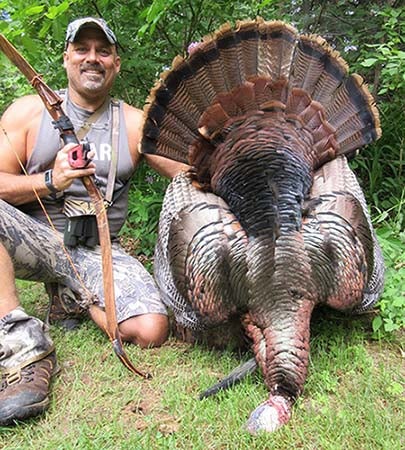
Gary Boals with his first turkey. He shot it with a Black Widow longbow and a Montec G5 tipped CX Heritage carbon arrow.
When the tom reached a quartering away position at seven yards, he drew his Black Widow, Osage Longbow. On release, the G5 tipped carbon arrow cut through the morning air and perfectly pegged the longbeard. He took a couple flopping steps and fell over. Gary had his first gobbler. After inspecting his trophy, he quickly made the traditional cell phone calls a few buddies. We always call up to brag, but if we get voice mail we gobble obnoxiously and hang up. When I heard Gary’s voice mail later that morning, I smiled widely.
Denny Sturgis Jr with another bagged turkey with a bow.
Spring turkey hunting is a lot of fun. And I consider shooting one a true accomplishment. A real feather in your cap both literally and figuratively.
A bow case to protect your recurve bow should be high on your list of archery gear must-haves, as let’s face it, recurve bows are valuable, both in cost, and the sentimental value that grows over time. A bow case for your recurve will help keep your bow safe. Plus, for many states it is a law to have your bow in a case when it is in the car.
With so many different cases out there what makes the best bow case for your recurve? You can spend more on your case than you did on your bow, but does that make it ‘more safe’ than the next case? Answer is… Maybe? Every case is going to have its advantages and disadvantages. Let’s take a look at a few styles and models of recurve bow cases here.
Hard Recurve Bow Cases
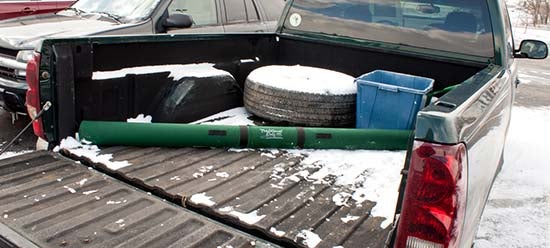
The 3Rivers Archery Travel Recurve Bow Cases are designed to take hard impacts. Click image to learn more about this case.
From airline approved travel bow cases to molded plastic, a hard bow case definitely has it on protection. Short of driving your car over them, they can take all sorts of punishment. Our 3Rivers travel bow cases offer the best on impact resistance. The Cordura ® outer shell adds plenty of style (definitely with our deluxe models that have leather end caps), and they fit many different size recurve bows, from one-piece to takedown recurves. So what’s the negative? Well, all of our travel models are more than $100 a piece, which for many archers, is almost as much as they spent on their bow.
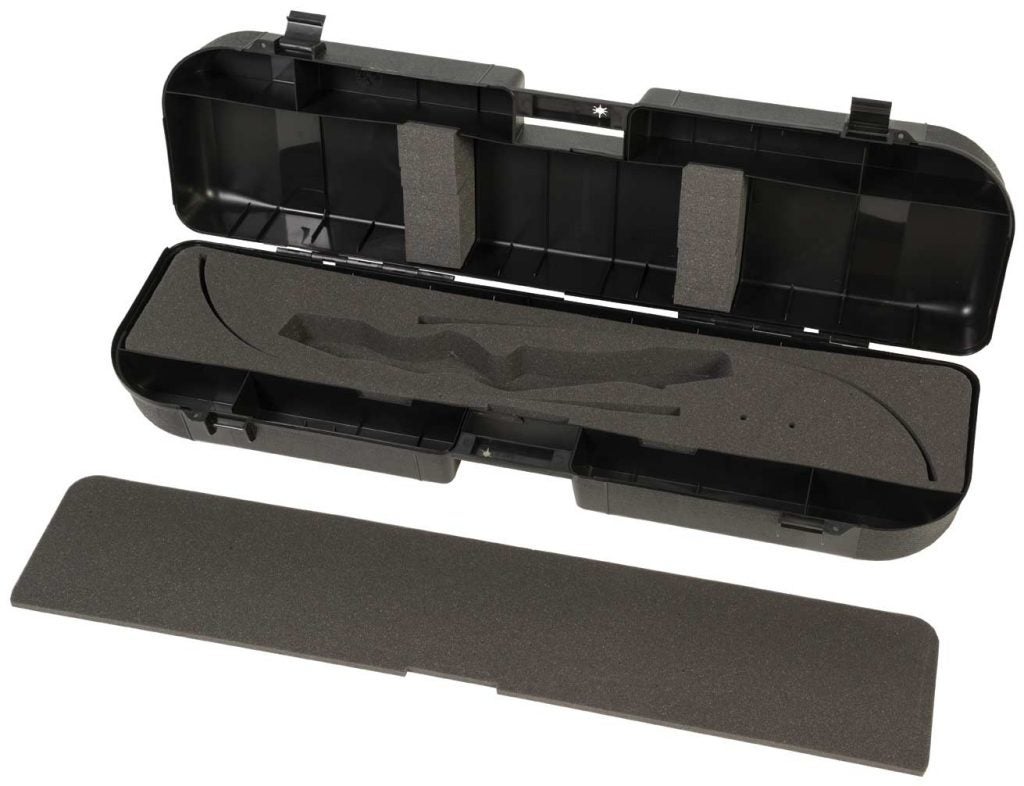
The Fleetwood Traveler Takedown Recurve Bow and Arrow Case is perfect for takedown recurve bows. Great bow case for the Samick Sage Recurve.
On a molded plastic case, like the Traveler takedown bow case (shown above), there is a foam cut interior providing lots of cushioning for storing your bow. The outer shell will chip if dropped on hard surfaces, but it’s solid protection when transporting your bow in the back of a pick-up truck. . A couple of drawbacks are that it’s not recommended for airline travel, and you have to disassemble your bow to put it away. But if you have a 3-piece takedown recurve, like the Samick Sage recurve, it is a solid option.
Soft Recurve Bow Cases
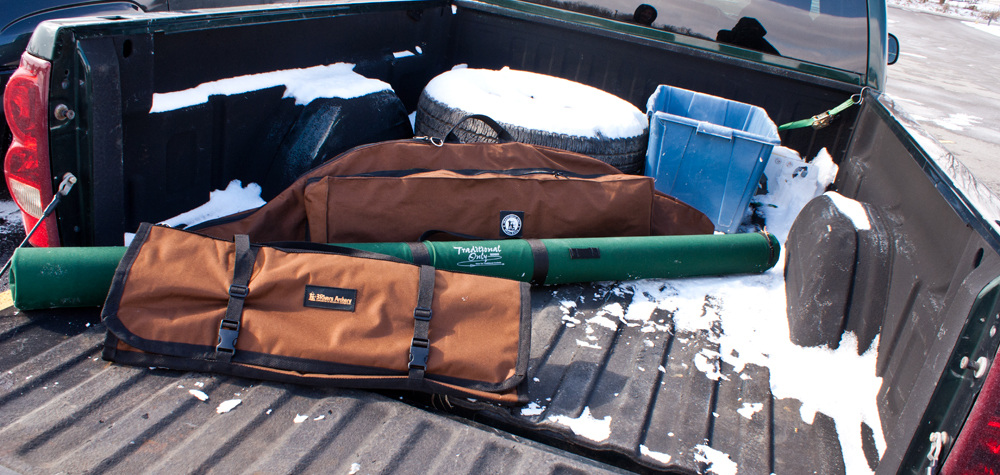
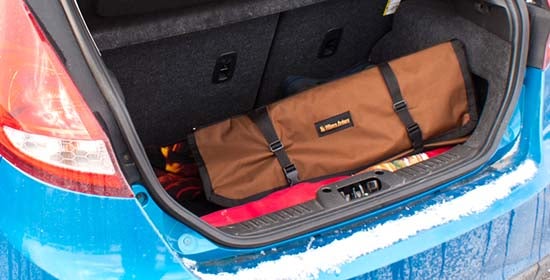
The 3Rivers Roll-Up Takedown Soft Recurve Case is great for takedown bows when you have tight spaces. Click image to read more about this case.
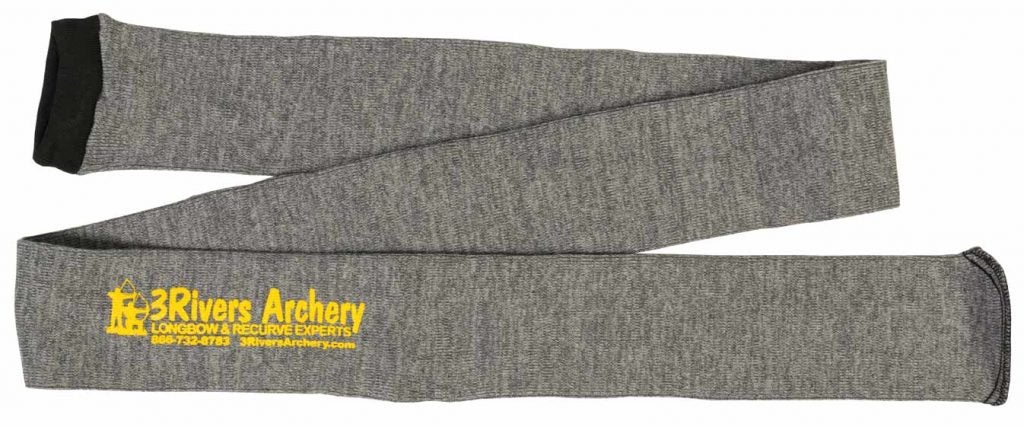
If you’re looking to keep your bow safe, but don’t need a ‘safe’ to do it, then a soft bow case is up your alley. You can choose from the most basic bow sock like our 3Rivers stretch bow sock (perfect for a backseat trip), up to bow and arrows cases like our 3Rivers Strung Recurve/Longbow case. There are tons of different options when it comes to soft shell bow cases, such as strung vs. unstrung, or one-piece vs. takedown. There are also options as far as the different materials used. Our 3Rivers line of cases uses durable Cordura® for an outer tough shell to shield against most nicks and scrapes, with a soft fleece lining to add a little cushion for added safety.
As basic of a case you can have for your bow, but the 3Rivers Stretch Bow Sock does get the job done
Some bow cases will have added value with pockets or space for arrows. These can be a great addition, as having all your archery gear in one spot can be a lifesaver, keeping you from ripping up floor panels in the truck looking for a spare shooting tab.
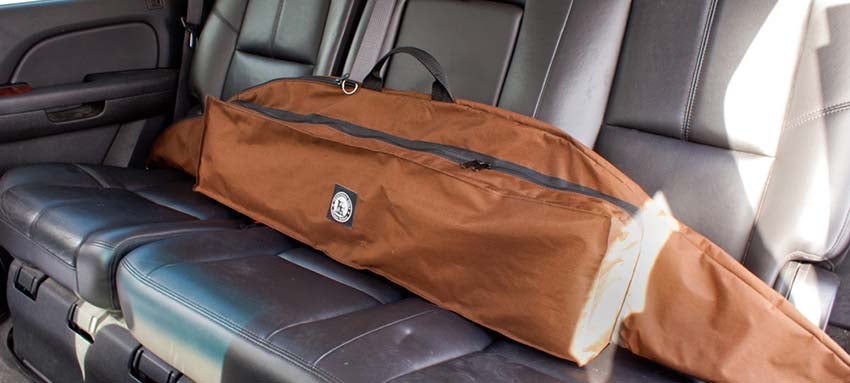
For backseat rides, the 3Rivers Strung Recurve/Longbow Soft Case works great. PLUS, it has a pocket for an Arrow Case, to keep all your shooting gear in one place
So what IS the Best Recurve Bow Case?
One of the best things about archery is how personalized it can be. Which makes this a hard question to answer. If you don’t plan on doing a lot of traveling in tight conditions, then a soft bow case may be the perfect fit for you, plus it saves money for future archery gear. Then again, having the peace of mind that a hard recurve bow case offers definitely warrants the cost when you have to shell out more money to replace a broken bow limb because you closed a car door on the tip. All comes down to what fits your style, and your budget.







.jpg "Welcome to the 3Rivers Archery Trophy Room")



 Get the Newsletter