






.jpg "Welcome to the 3Rivers Archer's Den")
Bow Fishing with Longbows and Recurves
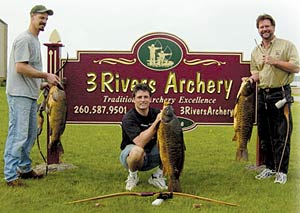
Bow Fishing is one of bow hunting’s most exciting and addicting pursuits. Hunting fish with a bow and arrow is action-filled and a perfect activity for introducing almost anyone, regardless of age or gender, to hunting with the bow and arrow. As a sport in the U.S., it has been around for decades. Fred Bear, of Bear Archery fame, helped popularize it in the 1950’s – 1960’s, and introduced many of the bow fishing products still in use today.
In the last 10 years though, bow fishing equipment has reached a whole new level, both in gear advancements and sheer numbers of archers participating in the sport. Much of the ‘old’ equipment is still in use, which speaks well of the simplistic efficiency of design and effectiveness. The more recent developments have been in high-end hybrid arrows, line attachment systems, and reels. Today, anyone interested in bow fishing with longbows or recurves can be as primitive as they wish, or as advanced as any other bow fisherman out there. Today bow fishing gear is available from the simple to the complex. Traditional bows, longbows and recurves, are perfectly suited to the rigors and demands of bowfishing and are actually the weapons of choice for many serious bowfishing enthusiasts. Today we’ll discuss gear selection for bow fishing with longbows and recurves.
Getting Started, Bow Fishing Gear
Let’s start simple. First, you’ll need a bow. In bowfishing, most shots are taken quickly at fish partially hidden or on the move. The natural point ability and smooth drawing characteristics of longbows and recurves make them perfectly suited for those situations. With traditional bows, you’ll be able to draw, swing, and shoot in one fluid motion. Depending on what fish you’re after, they may be close to the surface or three or more feet down. The refraction phenomenon that makes fish appear closer to the surface than they really are forces the shooter to aim lower than they think. (Depending on the depth of the fish, sometimes much lower.) It’s pretty easy to change your sight-picture when shooting an old recurve instinctively. In contrast, many bowfishing archers find that sights hurt more than they help. They’ve come to realize that when bowfishing, leave the sights at home. Besides, equipment used in bowfishing gets used hard, subjected to getting tossed around in a boat, dropped in the water, and other rough treatment. It’s easy to understand that many bowhunters choose to use a low-cost longbow or recurve instead of their fine-tuned big game bow hunting set-up. An old second-hand recurve picked up at a garage sale is perfect. The initial investment is low and you won’t have to worry about the bow taking a beating. Besides, you’ll be having too much fun to notice.
What kinds of bows? If you’re fishing from a boat, nothing beats a short recurve. The Bear Archery Super Mag 48″, and the Bear Archery 52″ Kodiak Magnum, both from Bear archery are perfect for this kind of bowfishing. Their short length allows you to shoot from a more natural position and you won’t have to be constantly distracted by watching your lower limb to keep it from hitting the side of the boat upon release. Whether you find a good deal on a nice old bow or invest in a new one, get ready to enjoy some of the most fun you’ll ever have with a bow in hand.
Choosing the Bow Fishing Reel
Next is the reel. When it comes to reels there’s quite a gap between the tried-and-true simple spun-aluminum reels that have been around for over 40 years and the modern Shakespeare Synergy and AMS Retriever® Pro reels. They all work well, but you’ll have to decide how serious your bowfishing will be and how much you want to spend getting set up.
There are two basic types of the spun-aluminum fish reels. The screw-on reel mounts to the front stabilizer bushing on your bow (if it has one), and the other reel is the tape-on bowfishing reel. They’re simple in design, extremely easy to use, dependable, and last for years. They’re basically a spool with a flared back and a rounded front. You tie your line tightly around the spool then wrap it ’round and ’round until you’ve filled the spool. Fifty feet of bow fishing line is normally all you’ll need. There’s a little clip at the top of the reel that holds the line in place until the force of the fish arrow launching from your bow pulls it out. The tape-on reel is actually still quite popular because it’s so easy to install. Tape it on and your ready to fish. When you get back home, just cut the tape and put the reel away. Pretty simple. Note: Install some leather, rubber, or other cushion under the metal attachment points so you won’t mar your bow’s finish. The screw-in reel is still the best seller though. The fact that it fits almost any bow on the market and retails between $15.00-$30.00 might have something to do with that. The truth of the matter is, these reels really do anything you need for small to mid-sized rough fish and that makes them pretty hard to beat.
From the basic reels it’s a big jump to the next level. You really don’t NEED the high-dollar models, but they work so well it’s hard to say no, especially once you’re hooked on bow fishing. Bow fishing enthusiasts have been hunting fish with big closed face, push-button reels for many years. As a matter of fact, for a long time the big Zebco reel on a screw-in reel-seat was the standard set-up for all serious bowfishing. In the beginning, you’d see some pretty crude homemade set-ups, and they had their share of tangles, snags, and other problems. Today, with commercially available reel seats and reels specifically designed for bowfishing you can rely on your gear to get you though many years with little or no trouble. The Zebco 808, with its adjustable drag, BIG string opening, and heavy-duty crank is popular for all kinds of bowfishing. If you go to any of the big bowfishing tournaments you’ll see many contestants shooting the Zebco set-up.
The AMS Retriever® Pro reel is arguably the finest bow fishing reel available. The most valuable feature is the
fact that the Retriever reel is always ready to shoot. Just ask anyone who has ever forgotten to push the release button on the Zebco, then shot at a fish and lost an arrow. On the conventional fishing reels, the line is released by pressing a button, but on the AMS Retriever® Pro reel the line is always released unless you’re pulling on the front engagement lever while you reel in your line. There’s noting to remember when you shoot. If you see a fish, shoot. If you try to reel it in and notice that the reel is just spinning, that’s when you’ll remember to pull the engagement lever in. As soon as you do, the line feeds in. It’s an excellent innovation. Line storage is unique in the Retriever reel as well. Instead of the line being wrapped on a spool the reel utilizes a plastic bottle. As you reel in the line, it simply stacks inside the bottle and even looks like a tangled mess from the outside. In reality, it’s an almost zero-drag shooting situation. When you release your fish arrow, the line screams out of the bottle. You’ll be able to shoot further than ever before. We’re in Indiana so we hunt mostly carp and needle nosed gar, for our conditions we feel the AMS is the best reel you can get. The Pro model is also corrosion resistant and the toughest bow fishing reel available. The quick adjust clamp makes setup and adjusting easy on your bow. Also features a built-in quiver for securing your bow fishing arrow when not in use.
So how do you attach your reel to your bow? As we mentioned previously, if you’re using the basic tape-on reel, you’ll simply tape it on to your bow so the drum is just under your bow hand, but not in the working portion of your lower limb. All the other reels are designed to screw on to your bow. In the 70’s and 80’s, almost all recurves came with front stabilizer bushings installed, but if you buy a new one today, chances are, you’ll need to install your own or pick up one of the commercial adapters. Bushing installation is relatively easy and once it’s done, you’re set for life. Then again, if you’d rather not drill any holes in your bow, there are strap-on adapters available. The Great Northern Traditional Gadget Adapter is specifically designed for longbows and recurves and accepts any conventional screw-on style reel or reel seat. Strap the adapter to your bow, screw your reel or reel seat to it, and you’re ready to go. AMS, one of the big boys of bowfishing offers their own version of a strap-on adapter, called the AMS Traditional Mount. It’s a coated metal arrangement with the same straps as found on the Great Northern product. The AMS mount has the added benefit of allowing the use of the AMS Retriever® reel as well as conventional reel attachments. Either of these adapters will save your from having to drill your bow and will work perfectly with their intended reels.
The Bow Fishing Arrow
When it comes to arrows for bowfishing with traditional bows nothing beats the venerable solid fiberglass fish arrow. The basic solid fiberglass fish arrow is still the workhorse of bowfishing everywhere and accounts for more fish every season than any other material. These heavy arrows punch through fish with authority and they can take a beating from fish thrashing around. Longbows and recurves shoot these heavy arrows well, so there’s no real advantage to invest in some of the lightweight high-tech arrows now available. You can pick up fish arrows either all set up and ready to go, or, you can buy the raw shafting then mix and match bowfishing points until you find a combination works best for you and the fish you hunt. You can’t go wrong with the tried and true solid fiberglass for all bowfishing with traditional bows. Note: Buy several, you don’t want to run out.
When discussing arrows we need to mention the AMS Safety Slide. When a bow fishing arrow is tied directly to the fishing line it’s possible for the line to snag as the arrow is in flight and if it does the arrow can snap back right at you. The safety slide keeps all the line in front of the reel and virtually eliminates that problem. We suggest you use them for your own safety.
Always carry extra bow fishing arrows. Take it from those of us who’ve learned the hard way. Imagine you’re having a blast, the carp are boiling on the surface and your line breaks with a fish on. You watch as your only arrow swims away. What now? Go home? Don’t let it happen to you. Carry extra fish arrows with you. How many depends on your tolerance to risk. If you think three will get you by, then take three. We normally take between three and five. Your extra fish arrows can be carried in a back quiver, your normal bow quiver, or you could rig a special quiver just for bowfishing. Regardless of the quiver you decide to use, make sure to have extra fish arrows with you every time you go out.
Have you ever seen how many bow fishing points are available?
Let us help out some here. A fish point has to penetrate and hold fish until you land them, then you want to be able to remove the point quickly. Price matters when selecting bowfishing points because this is one instance where you are paying for performance and speed. The Fin-Finder Big-Head Pro point is on the low end of the price range and they work well enough, but the entire tip needs to be totally unscrewed and removed from the arrow before you can pull it free. Then you have to screw it back on before you can get back to fishing. It’s a good low-cost option, just slow. When the fish are all around and everyone else is pounding them, it’s frustrating to have to mess with that kind of point. Then come points like the AMS Mayhem™ Bowfishing Point and Bohning Ruff Neck Ultra fish point. They’re faster and when you shoot a fish, two barbs that lay close to the body of the point when shot spread out when in or through a fish and open wide. They stay in that open position as long as there is resistance against them. Once you land your fish a couple quick turns of the head allows the barbs to extend backwards and the fish is easily removed. They’re a bit more money, but well worth it if you are serious about your bowfishing. Which point then is best for you? If you’re just getting started, why not start with the Fin-Finder Big-Head Pro point? The low cost helps when you’re buying all your gear at once and they work well. Once the excitement of bow fishing grabs you, you’ll want to try the better points, you may just jump to the top of the line. The good new is, they all work well. You can’t go wrong with any of the heads we’ve mentioned here.
One thing about a good day of bowfishing, it’s fun but it’s also wet! If you’ve been out there amongst them, you know how hard it can be on your favorite shooting glove. This is where the No-Glov is a glove-saver. In case you’re not familiar with them, a No-Glov is a set of rubber cylinders that slide onto your bow string and cushion your fingers. They are impervious to water and once installed on a bow set up for only bow fishing, you never have to worry about losing or damaging your good shooting glove or tab. They are cheap and are a perfect solution to the fish hunter’s finger protection dilemma. Some folks even set up a string just for bow fishing and install the No-Glov on it. That way by simply swapping strings you can instantly go from bow hunting to bowfishing. Note: Just as important as carrying extra fish arrows, carry an extra bow string.
(Click arrow to view DVD)
If you’re new to the sport and you don’t have anyone nearby to teach you the ins and outs you’ll find the bow fishing section of 3Rivers Archery Adventure Series Triple Threat DVD very informative. The bow fishing section was produced for those just getting started in bow fishing. The first 15 minutes or so we cover longbow and recurve set-up followed by bout a half an hour of bow fishing action with longbows and recurves. It’s an excellent DVD featuring Dale Karch, Byron Ferguson, and Byron’s two sons Zach and Shawn. With how-to information and bow fishing action it’s easy to understand why it’s a best seller.
Now that you’ve got all your gear it’s time to head out and go fishing. Once you get to your fishing spot it’s a good idea to take several practice shots so you can get used to the feel of your set-up and the trajectory of the heavy fish arrows. Remember to aim low! Always wear a pair of polarized sunglasses, they cut the glare and you not only see the fish better, you’ll catch fish moving that you would have otherwise never seen.
When you land your fish you’ll need to dispatch it with a sharp blow to the back of the head. We’ve seen everything from a big stick to a 16 oz hammer used for this. Use whatever you’re comfortable with. Since most areas won’t allow you to leave the fish there, bring a big cooler or trash can with a tight fitting lid for transporting your fish back home. Once home you can bury them in your garden. Some lakes have public disposal containers you can use. If they do, you can deposit there. Just don’t leave them behind.
Imagine, you’re walking the edge of the water and you spot a carp swimming by, but you’re ready! Your recurve comes up quickly and your eyes concentrate on the fish, you draw back, aim well below the fish and release. The water boils and you see your arrow dancing, about a foot of it showing above the water. You start pulling him in but he fights. The adrenaline dumps into your system and by the time you get the fish to shore you’re shaking with excitement. You’ve landed the fish but you’re the one who’s hooked! Once you experience bow fishing, it’s a life-long pursuit. Do yourself a favor and try bow fishing this season. Don’t miss out on the “heart pumping” excitement opportunity swimming in a pond, lake or river near you. If you want to get your kids away from the video games, take them along. Boys and girls alike, enjoy the excitement of bowfishing. Get them hooked while they’re young!
For more information contact:
3Rivers Archery
PO Box 517
Ashley IN 46705
1-260-587-9501
 Get the Newsletter