






FAQs
2.) I can't place an order on your website. I've tried to register! What's the problem?
3.) When I order an item online, how do I know it's really in stock at your store?
4.) How do I know what spine shafts to order?
5.) What does "Factory Spined" mean?
6.) What does "Hand Spined" mean?
7.) How do I install fur string silencers?
8.) How do I install Snakeskin backing for laminated bows?
9.) Which paint should I use?
10.) I'm not using your paints. Which fletching cement should I use?
11.) How can I adjust my Tru-Center tapering tool?
12.) How can I straighten my wooden shafts?
13.) Do vented broadheads whistle?
14.) Would there be any difference in the look and feel of a bow made with the takedown sleeve vs. a one-piece bow? Would it be noticeable in draw or vibration?
15.) I'd like to start making my own arrows, what do I need to get started?
16.) What shows and shoots will you be attending this year?
17.) I'm just getting started in Bowfishing, HELP!
18.) What size nocks do I need for the Legacy shafts I'm ordering?
19.) Why do I have to pay a minimum shipping fee? Can't you just put a 50 cent stamp on my small order and mail it?
20.) What's the best bow grip material and how do I install them?
21.) What's a rug rest and an arrow plate?
22.) How do I install a Rug Rest and Plate?
23.) Do I need an Arrow Holder?
24.) Are bow tip protectors important?
25.) When do I need to use a String Keeper?
26.) My bow has some vibration. How do I fix this?
27.) Do I need a Bow Stringer or will the "step-through" method work?
28.) This bow's too pretty to hunt with! What can I do?
29.) What can I do about unwanted noise during the draw?
30.) Which type of string silencer is best for me?
31.) When are brush buttons important?
32.) When should I wax my bow string and how do I do it?
33.) How do I use the string separator?
34.) What should I use, a glove or a tab?
35.) I emailed 3Rivers, why didn't they answer?
36.) What Should I Look for in a Recurve Bow?
37.) What Should I Look For in a Longbow?
38.) What is the E-Z Kut Guarantee and how do I process mine?
39.) What small game head should I use?
Can I visit your store, what are your store hours, and how do I get there?
Sure! We're easy to find and we welcome you to drop in for a visit and shop our warehouse any Saturday.
(You can still visit us during the week. You can fill out an order form and we can pull the items for you, or you can even call in an order and pick it up here whenever we're open. If you'd rather browse our warehouse yourself and shop, you can do that any Saturday from 9:00 AM-2:00 PM.)
Store Hours:
| Monday 9:00 AM - 5:00 PM | Warehouse Closed to the public - Order Pickup ONLY |
| Tuesday 9:00 AM - 5:00 PM | Warehouse Closed to the public - Order Pickup ONLY |
| Wednesday 9:00 AM - 5:00 PM | Warehouse Closed to the public - Order Pickup ONLY |
| Thursday 9:00 AM - 5:00 PM | Warehouse Closed to the public - Order Pickup ONLY |
| Friday 9:00 AM - 5:00 PM | Warehouse Closed to the public - Order Pickup ONLY |
| Saturday 9:00 AM - 2:00 PM | Warehouse Open to the public Shop the Warehouse! Try out bows on our range! |
If you're in our neck of the woods on a Saturday, we encourage you to stop in and enjoy a leisurely stroll through our archery shop. We've got walls full of all kinds of big and small game mounts, museum quality longbows, recurve bows, arrows, quivers, and a huge broadhead collection. We LIVE traditional archery and bowhunting and it's obvious when you visit.
Remember the range too! We have a private range for anyone who wants to try out a new bow. While you're here why not test drive one of our impressive Tomahawk Bows®?
It's really a traditional archery experience, enjoyable for the whole family.
Please Note:Our warehouse is open to the public for five hours every Saturday.
In an effort to ship all orders as quickly as possible the rest of the week you can still stop in and place an order, we're always happy to gather your goodies for you.
If you'd like to browse the warehouse yourself or test drive a new bow though, shoot for a Saturday.
Directions from the North
If you're coming down from the North come down Interstate 69.
(If you're traveling the 80-90 toll road, we're a short 15 minutes south of where the Indiana Toll Road, Hwy 80-90, and Interstate 69 intersect. From 80-90 take the Hwy 69 exit (#144) and go South toward Fort Wayne.) Once on 69 travel South to the Ashley-Hudson exit (#340) and turn to the right (West) the first road you see on your left is our road, HL Thompson Jr Dr. Turn left (South) there and we're the third business on the left. 3Rivers Archery 607 HL Thompson Jr Dr Ashley IN 46705
Directions from the South
If you're coming up from the South, head North on Hwy 69 to the Ashley-Hudson exit. (#340) At the end of the exit ramp, turn left (West) toward Ashley. You will cross back over Hwy 69. Once over 69 take the first road to your left, that's our road. (HL Thompson Jr Dr) We're the third business on the left. 3Rivers Archery 607 HL Thompson Jr Dr Ashley IN 46705
Please Note: I-69 Exit #140 was changed to Exit #340 in August, 2012.
I can't place an order on your website. I've tried to register! What's the problem?
This is a simple "Cookie" issue. It boils down to how your particular browser and any intervening firewalls are configured.
"Cookies" is an Internet term that refers to a packet of information that
a host computer (in this case, our Web server) uses to identify a visiting computer (in this case, your system running the browser). Each visiting computer is assigned a unique identification number that allows us to open and process a private shopping cart for you. You must enable your browser to accept cookies from the 3RiversArchery.com website. If you are running some type of "firewall" software and/or hardware you may have to stipulate that https://www.3riversarchery.com and https://www.3riversarchery.com are trusted sites and that cookies are allowed. If you are ordering from your workplace then the corporate firewall may block your cookies - it all depends upon the configuration of the corporate firewall.
We hope that helps clear things up for you. Please make sure that "Cookies" are working on your computer and try placing that order again!
When I order an item online, how do I know it's really in stock at your store?
We update our online inventory at least once an hour 24 hours a day. Still, when we get low on an item your shopping cart may show the item as available when we've really already sold that item to someone else. For instance, when we sweep in a batch of Internet orders, two people could have ordered the same item when we only had one on the shelf here back at the store. When we import those orders, the first one to have the item on the order gets it and the second order will show that item as back ordered even though the shopping cart showed that item as being in stock.
Many things can happen. Someone shopping in our store might buy the last one of a particular item. Then we may download Internet orders and even though our website thought we had one more in stock, in reality we might be out. Here again, our shopping cart didn't tell you that we were out, but we were.
It's rare, but it does happen. If it does, we'll contact you and see if you'd rather substitute another item or wait until the next shipment arrives.
We do apologize in advance! If this ever happens to you, please forgive us. We'll be in touch to see what you'd like to do. After all, it is YOUR order and we want you to be happy!
How do I know what spine shafts to order?
Most bows can shoot a variety of spines fairly well. If you are interested in finding an ideal arrow for a given bow, then the spine is crucial. Many things affect the spine selection. The following is a partial list of some of the more important information.
1) Your Draw Length.
2) The weight of your bow, AT YOUR DRAW LENGTH.
3) The type of string. B-50, Fast Flight, etc.
4) The length of your finished arrow. (From the valley of the nock to the back of the point.
5) The weight of the arrow points.
6) Laminated Longbow, Laminated Recurve, Self Bow.
7) How far from the center line of the bow is the edge of the sight window, or arrow pass?
8) What type or species of wood will the arrows be made from?
9) Parallel shafting or tapered?
If you can supply us with this information, we can help you decide on a starting point for your spine selection.
We ask for this much information because, "Anyone you ask can GUESS at what spine you need, but the more information you give US the more EDUCATED that guess can be."
If you would rather choose your own spine, here are some rules of thumb:
1) The standard string material, B-50 is requires no extra "figuring". A fast flight string requires a jump in spine of 5-7 pounds. The Artificial Sinew string is heavy, thick, and stretches very much. All the negative attributes of a poor string material. This will cost your bow much in performance, and a lighter spined shaft will be needed.
2) For every inch longer than 28" you will lose approx. 5 pounds of spine. So, to compensate for that, you must add the 5 pounds per inch back into the equation. Likewise, for every inch shorter you will gain approx. 5 pounds, so you will have to subtract the 5 pounds per inch from the equation.
3) Figure that a 125 grain point is the standard. A lighter point will "stiffen" an arrow and make it shoot as though it were a bit heavier in spine. A heavier point will in turn "weaken" it, making it shoot as though it was a bit lighter in spine.
4) As a rule, laminated recurves place more energy into the shaft than the other bows do, so they need stiffer arrow shafting. Laminated longbows place more energy into the back of an arrow than a self bow. When you enter the world of the self bow you are in no man's land. Now you need to consider the wood that the bow was made of, how efficient the limbs are, how much string follow the limbs have taken, how far from center shot is the arrow pass, etc. Most self bows require a much lighter spined shaft than you would think.
5) The whole question of center shot is pretty simple, but sometimes misunderstood. The further the arrow is from the center line of the bow when shot, the more of the bow's riser the arrow must flex around to " go straight to where the archer is looking." So, it must be a bit more flexible, willing to bend, have less spine. The closer to the center line the sight window or arrow pass is, the less of the riser the arrow has to flex around and the stiffer the arrow must be.
6) Different woods recover from the archer's paradox differently. A deflection reading is static. The shot sequence is dynamic. Each wood species is a bit different than the next, so a "50-55" Port Orford Cedar arrow will not shoot the same as a "50-55" Laminated Birch arrow. Woods that have a quick recovery rate shoot as though they were of a stiffer spine rating. Likewise, wood with a sluggish recovery rate shoot as though they were of a weaker spine rating.
What Does "Factory Spined" Mean?
We get this question a lot and it is really something that needs a complete explanation. Factory spined really means, "Whatever spine the manufacturer assigned the shaft." So, if I am a manufacturer, I run the shafting through my spine tester, take a measurement, assign it a spine number and put the shaft in the appropriate bin. Those bins will be filled with shafts that ON MY SPINE TESTER were in that range. (My spine tester may not match yours!) Also, most manufacturers do not take the time to align the grain against the deflection force and few take more than one reading. What does that mean? It means if you've made or purchased your own spine tester and you test shafts that are supposed to be, 50-55, you may get readings of 47-58. It does not always happen this way, but it can. Normally you'll find them to fall very close to the advertised parameters.
We have been spot checking our shafting and we have been finding them to be very close to the advertised spine. Once in a while we get a phone call from someone who just hand spined their shafting stating that their 50-55 shafts worked out to be: 2-47#, 2-49#, 6-50#, 2-54#. This can happen. This is not always the case but don't be surprised if you see that in a batch of "factory spined" shafting. Most of the time, barring any drastic spine differences, these shafts when made into arrows will fly just fine out of the bow you plan to use them in. Especially when close range hunting is the end use. Granted, they will not fly quite as well as a perfectly matched set would. But if you want "Hand Spined" instead of factory spined you'll either have to purchase a spine tester, buy your shafts in bulk, and spine them yourself, OR purchase them from a full time arrow builder that spines and weighs every shaft that comes through their door. Those shafts are going to cost you more, but they should. Someone else did the work.
See our youtube video about Arrow Spining here...
What Does "Hand Spined" Mean?
Hand spining is a slow and tedious process that is very accurate if properly done. First you should straighten your shafting. If the shafting is crooked it will be more difficult to calculate the reading. Then before using your spine tester, make sure that it is calibrated for the diameter of shaft that you are planning to test. This is also called "zeroing the tester". Place your first shaft on the spine tester with the edge of the grain opposite the pressure of the deflection weight. Ignore the first reading. Turn the shaft 180 degrees and take a reading. We'll say it's 56. Turn the shaft again 180 degrees and take a reading. It's 50. Turn the shaft another 180 degrees. It's 56. Turn the shaft another 180 degrees. It's 50. Calculate the average. That's 53. Mark the shaft 53. After about 6 shafts, double check your spine tester to make sure it is still "zeroed". If it has moved, you'll have to re-spine any shafts in question. It'll take you a while at first, but eventually you'll get faster. Still, now you can see why the manufacturer can not afford to hand spine the shafting. He would have to raise the price of his shafting to his distributors, and you'd probably see the retail price of shafting more than double! Hand spining is best done by the end user. Normally the end user does not mind investing the extra time to get a little more precision in his arrows.
If you do not care to invest the time and money necessary to set yourself up for hand spining but you still want perfectly matched arrows you'll have to contact a professional arrow builder. There are many of them out there. They will offer not only hand spined arrows, but they will also weight match them for you. Many will offer shafting like this: Hand spined to within five pounds, weight matched to within plus or minus 10 grains. If that's what you are looking for, then go for it and be prepared to pay for it. The arrow builders are taking the time and offering you a service. They deserve to get paid for that service.
See our youtube video about Hand Straightening here...
Installing Fur String Silencers
Instructions for Installation
Starting about 10" from the loop, take your bowstring that is not under tension and spread the strands of the string apart into two groups of approximately half the strands strands. This will create two sections or "bundles" of string strands.
Insert ¼" of the end of the fur silencer between the two bundles of strands. Wrap the rest of the silencer around both bundles at the same time in a "barber pole" fashion until you reach ½" from the end of the silencer. Once again, spread the strands of the string apart to form two bundles and insert the last ¼" of the fur silencer between the bundles. At this point it's a good idea to twist the string a couple of times. This will help keep the silencer in place.
Repeat for the other side.
Once you shoot the bow a few times, the fur on the silencer starts to "lock" upon itself and virtually completes its own installation.
We hope that this helps!
We also have a helpful youtube video
Furnished by your friends at 3Rivers Archery.
How to install Snakeskin backing for laminated bows:
For snakeskin backing laminated bows we recommend using a quality contact cement such as Barge Cement. The skin itself must be dry when you are applying it. If you dry your own skin, you can control the shape and straightness of the skin. If you buy a pre-dried skin and do not care for the pattern or straightness of the pattern, you will have to re-hydrate the skin, reposition the skin, and re-dry the skin.
For Drying of skins, we recommend using simple cardboard and stick pins. Position the skin on the cardboard, scale side down, and stretch it slightly as you push the pins into the cardboard. Be careful! Do not push the pins all the way through and into your hands or furniture. Watch the pattern of the skin as you tack it down. Keep the center line straight and keep the pattern symmetrical. It will make the gluing process easier if you do. When the skins are dry, you are ready to continue.
Prepare the surface of the limbs by thoroughly cleaning and degreasing them. Mineral Spirits or regular Rubbing Alcohol will work well for this as it will not attack the resins in the fiberglass. You do not have to rough up the surface of your bow. The Barge Cement will hold even on smooth fiberglass
If you have a padded vise, you may want to use that to secure your bow at the handle. If not, you will have to come up with an alternative method of securing the bow. When your bow is secured, you can work with both hands. This project is much easier if you can use both hands.
Apply a thin, even layer of Barge Cement to the surface of the bow that will receive the snake skins. As that is drying, apply a thin, even layer of Barge Cement to the surface of the snake skins that will be in contact with the bow. Allow that to dry for a couple of minutes.
Now, starting at the handle section, line up the center of the snake skin's pattern with the centerline of the bow. Touch the two glued surfaces together there and while holding the far end up and out of the way, slowly and smoothly slide your near finger over the skin onto the bow all the while checking for the proper alignment of the pattern of the skin on the surface of the bow. Continue until you reach the tip of the limb. (Repeat for the other side.)
Trim with a sharp utility knife such as our "Snap-Knife". You can use the bow limb as a guide for the blade cutting from the grip out to the tip but be careful and do not cut the bow itself.
To remove the scales, use a piece of leather or coarse cloth and carefully rub against the grain of the scales. (From the tip towards the handle.) You will see the scales "jump" off the skin. Then with a piece of masking tape, this time going with the grain of the scales, (From the grip section to the tip section.) press the tape onto the top of the skin and slowly, carefully pull it up and away from the skin. The remaining scales should come off during this operation
I want to paint my arrows, which paint should I use?
The safest way to start is to choose one "family" of products and stick with it until you feel the urge to experiment. We offer two real "families" of paints; Bohning and the 3Rivers gasket and cresting lacquers. The choice is really up to the individual arrow builder.
Bohning offers quite a few color choices and even manufactures all of their own adhesives. Every Bohning product will work with every other Bohning product.
Ferr-L-Tite works well for mounting your points.
If you ever want to attempt mixing products from different manufacturers, please use caution and only test on scrap pieces of shafting, etc. It's very disappointing to get to one of the last steps of the arrow building process only to find that your once beautiful arrows are now full of wrinkles, and the paint seems to be melting right before your very eyes!
We do also offer water based cresting paint. Water based cresting paints will not attack any of the finishes that we know of. So, even though we have warned you to use caution when mixing families of products, we are here to tell you that water based cresting paints will work over any clear sealer that we have seen. So, if you clear coated in Bohning, you could crest over the Bohning knowing that the water based paint will not attack the solvent based finish below.
See our youtube video about cresting here...
I'm using a finish that you don't sell. Which fletching cement should I use?
Of course we can't possibly know which adhesive will stick to finishes that we don't even sell, but we can tell you this. No one has EVER called us with an adhesion failure when using the Saunders Arrow Mate cement or the Bohning Fletching Tape.
See our youtube video on using Fletching Tape here...
I'm having trouble getting my Tru-Center Taper Tool to cut smoothly. What can I do?
The Tru-Center taper tool must be adjusted correctly for proper angles and depth of cut. To facilitate this, we utilize slotted blades. The slotted blades are very adjustable. This allows you to adjust the blade precisely to allow for the differences between the machined bodies of the tool. The company that machines the bodies for us can't hold close enough tolerances to allow us to use blades that have holes instead of slots. So, we have the slotted blades specially made for us. This can also cause the blades to be installed incorrectly. If that happens it will be natural to assume that the tool is not working. The real problem though is the proper adjusting of the blades. As the blades are moved in closer to the shaft, they cut deeper. If they are mounted too deep, then they will cut too deep. They will snag and tear at the shaft resulted in a "Chewed" look. If this happens, you need to pull the blade further away from the shaft and try it again. As easy as it is to install the blades too deep, you can also install the blades too far away from the shaft. In that case, the blade may not be cutting deeply enough, or even not at all. The perfect adjustment is in-between. It may take some initial patience to get the tool adjusted properly but once you do you will have the satisfaction of near perfect nock and point tapers.
Hint:
Sometimes a blade must be flipped so the bevel is down to get the nice smooth cutting action.
It may help in the initial setup to have a well tapered nock end and a point end of a shaft that you can insert into the tool to act as a guide. Slide the blade into place just barely against the shaft and on the same angle as the taper on that shaft. That should get you close, then you would only need to fine tune from there.
Once in a great while we do get a truly "defective" tool. One that just can't be adjusted well. If you get one of those, contact us for a return authorization number and we'll swap you. You send us the bad one and we'll send you a new one. It's as easy as that.
See our youtube video on using the Tru Center Taper Tool here...
My wooden shafts/arrows are not all straight. What can I do about that?
The wooden arrow is steeped in the history of archery and the mystique of days gone by. They are, after all, a natural substance, subject to the laws of nature. One of those laws is, "Wood reacts to the conditions around it." In other words, wooden arrows do not stay straight all by themselves, they move around as they react to the conditions of the world around them. If you want to shoot wooden arrows, you must learn the skills that go hand in hand with using them. One of those skills is straightening. You must learn to straighten them. The age old, "heel of the hand" method has worked well for countless years and continues to do so. It is not difficult to learn, but will take a while to master. It is described in detail in our film, "Crafting Traditional Wood Arrows" which is available on DVD. Many compression style straightening aids have also come onto the scene in the last couple of years. The difference between the "heel of the hand" method and the "compression" is that when using the "heel of the hand method", you GENTLY stretch the short side of the curve while again, GENTLY compressing the long side of the curve against a soft fleshy heel of the hand. If done well, the cells will accomplish this stretching and compressing without damaging the cells themselves. There is a bit of elasticity in good arrow woods and this is what allows this method to work so well. The "compression", "hook" or "burnishing" method uses tools that are rubbed on the surface of the long side of the bend. This rubbing actually slightly crushes the surface of the cells. They are forced into being shorter by pressure from a hard tool. This "burnishing" is more permanent as well as more invasive. The truth of the matter is though is this, the burnishing works and the arrows still fly well and true. So, if you have tried the "heel of the hand" method and it's not working for you, pick up one of the straightening tools and give them a try. It does not matter how you get your arrows straight, as long as you do.
See our youtube video on shaft straightening here...
Do vented broadheads "whistle"?
We wouldn't say that they "whistle", but they can make a little noise. Let's face it, call it what you like, all arrows as they fly through the air make some sort of noise. As far as additional sound from the broadhead goes, solid two blade heads make the least amount of noise and vented heads make the most. While we're at it, taller feathers also make more noise than shorter feathers. How does this affect your hunting? It is our experience that the actual sound an arrow makes in flight does not alarm the animals that they are shot at. We feel that you should disregard "in flight arrow noise" as a criteria of selecting the best broadhead for the job. The "upside" to vented heads is that they normally exhibit more stable flight characteristics. They are much less likely to offend you with broadhead steering or wind planning. The bottom line is this, the advantages offered by the venting of a broadhead far out weigh any negative side effect such as additional noise in flight.
Would there be any difference in the look and feel of a bow made with the takedown sleeve vs. a one-piece bow? Would it be noticeable in draw or vibration?
This all depends on the way the bow is built. We must assume that we are comparing well designed bows in both categories. If that is the case, then the following observations should hold true.
Take down bows are awesome! Just the convenience of storage and transportation alone should be reason enough to have us standing in line for them.
With the clever use of "Bondo" on the sleeve and shrewd placement of some type of grip material or a"Shur-Grip", you can achieve the look and feel of a one-piece longbow while maintaining all of the advantages of a take down longbow.
Whether you use the take down sleeve to make a take down bow from scratch, or convert an existing one piece bow into a take down, the attachment point of the system is in the grip or "handle." The handle area is a non-working part of the bow, so as far as the limbs are concerned, there is no difference between the solid one-piece and the two-piece take down. You should notice no difference in the drawing or characteristics of the bow. The opposite is true in the world of fishing rods. In the fishing world, one-piece rods enjoy a relatively unfettered opportunity to transfer their energy to the lure and line during the cast. A fishing rod with several ferrules will have a completely different action than a one-piece. The entire cast, action, and "feel" of the rod will be noticeably different. This is because the ferrules impede and interfere with the energy transfer. This is simply not the case when dealing with the take down longbows as we have described them.
The sleeve will however add additional mass weight to the bow. For shooting stability this is good. A little extra weight will help to keep the bow pointing the way you pointed it. It will be a little more resistant to unwanted movement during your shot. Additionally, the extra mass will help to reduce any noticeable "thump" or "harshness" that you may experience when shooting arrows of light physical weight.
The bottom line is this. Two piece take down longbows are among the most convenient bows for hunting or target shooting that we have ever had access to. There is no reason to shy away from any two piece take down system that utilizes the grip area of the handle for the attachment site. The sleeves are good and the dovetail system is even better. Come visit our shop, or see us at one of the shows. We should have some bows of both kinds for you to shoot for yourself. I'll bet you this, if you do end up owning one, you'll never regret it.
I'd like to start making my own arrows, what do I need to get started?
Basic Arrow Building Equipment and needs.
A good attitude and a determination to succeed will be your best tools. Take advantage of any knowledge base available to you.
Our Crafting Traditional Wood Arrows DVD will be your absolute best investment to start with. Other books, videos, friends, professionals, etc., can also be great sources of information. Build your arrows boldly. If you do not risk, you will not learn.
Shafting. This is the body of the arrow. It must be in good shape. My personal preference is Port Orford Cedar, but I have used and can recommend any of the following: Norway Pine, Hex-Shafts, Canadian Pine, Sitka Spruce, Alaska Yellow Cedar, Maple, and Laminated Birch. Shaft Straightening Aids. Learn to hand straighten. If you just don't catch on I'd try the hook first. It is the least expensive and does a fine job as long as you don't push too hard.
Fletching. The heart of the Fletcher's craft. Trueflight is my favorite choice. The grind is the best and most consistent of any I've ever seen. That being said, nearly any feather will work. The fletcher decides where he is on the wheel of arrow building and uses what he likes. Tests different types, and normally settles on one. Feather shapes? I use mostly shield and a modified Pope and Young. Most commercially available feather shapes have stood the test of time and will give very good results when fletched. Buy them already cut to shape at first. Later if you want to experiment you can buy burners or choppers. Don't worry about that in the beginning.
Nocks. I prefer the Bohning Classic nocks. They are a high quality plastic, not brittle, and manufactured with great precision. They have an indexer and are available in many colors.
Broadheads. I like the Woodsman® 3-blade heads the best. (Woodsman broadheads are available in glue-on or screw-in) If you're more into two and four-bladed broadheads then consider one of the Magnus broadheads. They are also available in screw-in and glue-on in numerous two and four blade designs. I have had very good results with the old standard two blade Zwickey Eskimo too. Broadheads are very personal. Use what you have faith in. If you're not sure, try the Woodsman™. They're easy to sharpen, fly great, and cut big holes. They have a reputation for complete pass-throughs. That's why we call them, "The most deadly broadhead you'll ever shoot".
Field Points. We sell thousands of them in many different weights. Get the ones that match the weight of your broadheads. They're available in screw-in and glue-on styles.
Stains. I used to use all oil based stains. I have had some off and on trouble with them and have switched to alcohol based stains. I like the penetrating qualities and the bright colors available. You can also mix the colors to get any combination that you desire. I have not played much with the water base stains yet, but from what I've seen, they should do quite well.
Paints/Sealers/Finishes. I have used the Bohning products for about 17 years. I am familiar with them, know how they work, what I can get away with, etc.. If you use Bohning products, you must use ALL Bohning products. So, as someone just getting started, I'd suggest starting with and sticking with a good water based sealer like the one we now offer. We now offer a fantastic water based sealer in both a clear finish and a white dipping paint for cap dipping. They yield a beautiful gloss finish, dry quickly, and eliminate the solvent based fumes present in all of the non-water based sealers. Water based sealers will eventually replace all of the solvent based ones. It's just a matter of time.
Dipping tubes. I like the speed coat dipper cap system. It cuts down on thinner/fumes and is much faster than conventional dipping. How do I normally build my arrows? By conventional dipping because I know that system the best. Someone first starting, I'd say go for the gasket system. Big dipper and a speed coat dipper cap.
Adhesives. If you use Bohning paints, use Fletch-Tite Platinum for your feathers. If you use other paints/sealers, you will have to experiment. Duco works on most finishes as does the Saunders Arrow Mate adhesive that we sell. The best may very well be the Bohning feather tape. It will work on any finish that I have heard of so far. Any quality hot-melt glue will work for the points. We now have two kinds, Ferr-L-Tite and generic Hot Melt. Both are good.
Cresting Lathes. We sell the Bohning Pro-Crester and Junior-Crester. They both work fine. Bob Burton sells a very nice unit called a Phillips. They help to stabilize the shaft if it's just a little crooked and that makes painting precise pinstripes much easier.
Cresting Brushes. I have been using the sable brushes that we sell. They are very good brushes, very reasonably priced and I have had great results.
Cresting Rack. You'll need something to rest your arrows on while cresting them. We do not sell them, but you can easily make something.
Cresting Paint. All the cresting paint we sell is good. It boils down to the family again. Stick within a family unless using the water based pains from Whispering Wind. They should go over anything.
Taper Tools. I like our Tru-Center taper tool. It can be tricky to adjust, but once it is adjusted well, it is a great tool. They're a very good value for the dollar. The woodchuck power taper tool is an excellent tool too. A little more expensive, but a good taper tool that can do any size and any type of wood.
. I roll a knife along the mark and snap off the shaft. That's all the home builder needs. If you have a band saw or some other power saw that you'd prefer to use, that's fine. The knife works for me.
Fletching Jigs. The Bitzenburger has been the best of the best for many years. They are easy to use and will last several lifetimes. They are also costly. My second choice is the BPE. They are very well engineered. Have a ton of experimental flexibility and are much more reasonably priced.
Spine Testers. Purchase your shafting pre-spined and weighed at first. These tools are fantastic for the home fletcher once he/she really wants to get into the craft but at first add to much cost to the equipment purchase.
Grain Scales. At first pick up the 3Rivers pocket grain scale. It's very inexpensive, does a great job and will let you know how well matched your finished arrows are. The electronic scales are my favorite for speed and accuracy when later you are buying your shafts by the hundred and re weighing, re-spining them all.
We hope that helps!
What shows and shoots will you be attending this year?
3Rivers Archery will not be set up at trade shows or events during the upcoming seasons. Even if we aren't there manning a booth, you'll still be likely to see us in the crowd and on the range shooting and having fun. If we're camped, stop by and introduce yourself. We enjoy meeting our fellow longbow and recurve shooters.
I'm just getting started in Bowfishing, HELP!
Bowfishing is one of the most action-packed forms of bowhunting available to archers anywhere. The season on these rough fish is generous and they are active most of the time. It's easy to get started and a ton of fun so read on! If you are new to the sport, we offer an excellent Bowfishing segment on our 3Rivers Archery Adventure Series Triple Threat DVD.
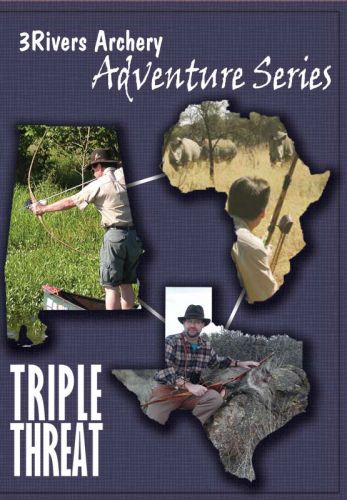
This bowfishing DVD from 3Rivers Archery combines bowfishing how-to and action. 3Rivers owner, Dale Karch, shows traditional bow set up from tape on reels to the more sophisticated AMS retriever reels, as well as arrow selection, arrow setup, and some of the more handy accessories available. Once the bows are ready, the fishing action starts. Over 30 minutes of nonstop bowfishing action with Dale, Byron Ferguson, and Byron's two sons Shawn and Zach. It runs about 45 minutes and is well worth the small investment.
See our youtube Bowfishing Trailer here...
First let's start with a basic equipment list:
1.) Bow
Of course you'll need a bow. Any basic bow that's comfortable for you to draw will work. We would recommend not less than about 35 pounds at your draw length. Many of our bows are ideal for bowfishing. The edge Takedown Recurve is an excellent bow fishing bow, with the required AMO bushings and plunger bushing already installed.
2.) Reel
When selecting a bowfishing reel you enter an area of return on your investment. Like when buying a car, you pay extra for additional features. For those who like simplicity and value, there are screw-in and tape-on reels. These reels are very simple yet extremely functional. For those who like all the bells and whistles and take their bowfishing seriously, there is no better reel available in our opinion than the AMS Retriever Reel. If you're looking for the best there is, go with the Retriever Reel from AMS. (All of these reels come with the appropriate fishing line.)
3.) Fish Arrows
Fish arrows come in many configurations. We suggest that you start with the basics. Then when you decide you're excited about bowfishing, you can upgrade to more advanced equipment. (Side note on fish arrows. Make sure to have a couple of extra fish arrows with you when you head out for a day of bowfishing. Once in a while something happens and you'll lose an arrow. It's much better to have a couple spares with you than to have to run to the nearest archery shop!)
4.) Miscellaneous Equipment
As in most sports, there will be equipment that is nice to have, but is not mandatory. The AMS Safety Slide is one of them. It eliminates the possibility of arrow snapback. Not only does this protect you and those around you, but it allows more accurate shot placement, which of course means more fish! Then there's the No-Glove. They are soft rubber parts that slide onto the string and not only cushion your fingers on the string, but form a quick and reliable arrow locator on your string. (Note: These are good on youth bows as well. It's much easier for kids to get used to these than learning to use a tab or glove.) There are many different arrows and points to choose from as well. See our online Bowfishing Section for many other items.
5.) General Tips
Now for a few tips to help your first fishing forays be more successful.
The most important thing to learn it to Aim Low! There is something called "light refraction" that makes things in water look closer to the surface than they really are. As a test at home. Fill a clear drinking glass with water and put a pencil in it. See how the pencil looks like it bends? That's the illusion caused by the light refraction. Aim below where you think the fish really are to hit them. The deeper they are, the more pronounced the light refraction will be.
You are going to miss fish. Probably quite a few of them. Don't let it get to you. In bowfishing you normally get lots of shooting action, so if you miss, reel in your arrow and shoot again!
Wear polarized glasses. The glare off the water makes it very difficult to see submerged fish. Regular sunglasses do not cut out the glare. Polarized glasses do. They are available in most stores that sell regular fishing equipment. Make sure you get a pair of these, you'll see and shoot more fish if you do.
Make sure you get a copy of your local hunting and fishing regulations. Learn to identify the fish that are legal to shoot in your state. In most areas only "rough" fish may be taken with a bow and arrow. Make sure you know that you are shooting at a legal fish or don't shoot!
If you have a boat, take that out for a day of bowfishing fun. Night fishing is a blast too. Rig your boat with some auxiliary lighting and travel the edges of the lake. Many times you'll see some of the larger fish up in the shallows at night. If your boat will support it, a platform is a nice addition. Your shots are easier to make if you're shooting straight down.
Make sure you get out there and give it a try! You'll have a blast. Bowfishing offers plenty of action and it's fun for the entire family. Get yourself geared up and go!
What size nocks do I need for the Legacy shafts I'm ordering?
Legacy aluminum shafting is easy to buy nocks for. The answer is in the first two numbers of the shaft size you are buying. Let's say you're looking at a 2216 shaft. The first two numbers are "22". They tell you what diameter the shaft is in 64'ths of an inch. That makes a 2216, 22/64" (11/32") in diameter. You'd need 11/32" nocks. Likewise a 2020 is 20/64" (5/16"). For the 2020's you need 5/16" nocks. As a side note, the second two numbers are the wall thickness in thousandths of an inch.
Why do I have to pay a minimum shipping fee? Can't you just put a 50 cent stamp on my small order and mail it?
We get this question all the time! The answer to this is complicated so bear with us.
First, when you run a mail-order company like ours there's no real "simple" order. There is much more to an order than most people realize. We have LOTS of overhead and the order process is complex. We have to have someone here to take the order, to process the order, to print it, pick it, pack it, tape it, run it across the manifest, and ship it. (That doesn't even take into consideration the cost of the box, tape, and packing materials.) Then we have to have people in customer service to be able to answer questions about the order, the status of the order, etc. That goes for an inquiry even six months down the road! We have to be able to look up the order and prove that it was shipped, who it was shipped to, and when was it delivered. If we can't, we have to reship. You can't get that kind of information with a 50 cent stamp.
We do listen to customer feedback though and we have made making small orders much easier. We used to have a $15.00 minimum order. Back then, we refused to accept any order under $15.00. Now, we allow small orders, but we don't alter the shipping. (If you compare our minimum shipping rates to other stores though I believe you'll find us very competitive.) This way, you can order a few small items, you just have to pay the shipping on them. We think that's a pretty good service.
How far can you drive these days for $5.00-$6.00. Not very far. So paying a $5.00-$6.00 shipping fee can start sounding like a great deal more than anything else.
So, depending on how you look at it, low minimum shipping rates seem VERY reasonable. Wouldn't you agree?
What's the best bow grip material and how do I install them?
The selection of bow grip materials is varied but the top sellers are the Shur-Grip and the adhesive-backed leather grips. The "Shur-Grip" is a seamless rubber tube that rolls onto your longbow (and some recurves) and stretches to fit the curves of the grip like a skintight glove. These grips offer solid non-slip positioning in the hand, they're impervious to water or snow, they're easy to install, and they're reasonably priced. (A trick to installing these on recurves with a little more mass on the riser is to roll them up like a doughnut and over a short piece of parachute cord. Then when you get to the largest section of the riser, you can use the rope like a flexible lever and force the "Shur-Grip" up and over the largest section of the riser.) These grips have a universal appeal and you'll see them on bows being shot by both the new "modern-traditionalist" and the older "vintage-traditionalist". Next in line is the adhesive-backed leather grip. This one appeals more to the "vintage-traditionalist" but its versatility keeps it a top seller. Not only can you use this item as a grip material, but you can use the scrap for arrow rests and plates. To install the adhesive-backed grip, first measure your bow grip to determine what height and width is needed, then "cut-peel-and-stick". (A good tip for trimming the seam neatly is to wrap the grip around the handle and overlap the bottom and top layers. Then, cut through both layers at the same time with a utility knife.) Remember to save the extra pieces.
See our youtube videos on installing bow grips here...
What's a rug rest and an arrow plate?
When it comes to arrow rests and arrow plates the selection is vast.
(See rug
rests and arrow plates) To clarify the "rug rest" is a pad that is
installed on the arrow shelf, the little ledge on the side of a longbow
or recurve where the arrow "rests". The "arrow plate" is installed on
the side of the sight window, right where the arrow rubs against it during
the shot sequence.
Not many longbow and recurve shooters shoot elevated rests anymore. But the majority of traditional shooters use rests and plates of rug, calf hair, or leather materials.
How do I install a Rug Rest and Plate?
The "Rug Rest" and "Rug Plate" are our all-time best sellers in this category. They're adhesive backed for easy installation. The side plate is ready to install. You simply peel off the backing and stick the plate where you want it. The rest needs to be trimmed to fit. Set it on the shelf, draw the shape of the shelf edge on the bottom, then trim to fit before the peel and stick process. The rug rest and rug plate are available in black or brown, work for right or left handed bows, and are inexpensive. Leather and calf-hair versions of these accessories are available as well.
One package deal that has been a strong seller for over 20 years is the "Bear Hair Rest & Plate". This set, from Bear Archery, offers the same rug rest and leather side plate combo that comes standard on all Fred Bear recurve bows.
Do I need an Arrow Holder?
Arrow holders are popular with both compound and traditional shooters. The best is the "Kwik-Lok" arrow holder. It's adhesive backed for quick installation, cut out for a plunger, and the rubber used in them is silent and supple, even in frigid temps. It's the perfect accessory for treestand hunters who either hang their bows from a hook, or stand and hold their bow for hours. (The arrow holder eliminates the bowhunter having to keep their index finger hooked over the arrow all the time. Which is especially advantageous in the cold.)
Are bow tip protectors important?
Many of us traditional bow shooters like to lean on our bows. When we do this, the lower limb tip takes a beating unless it's protected. That's why bow tip protectors are "must have" accessories. They're available in leather as well as plastic and rubber versions. The leather kind is novel and attractive, but the plastic and rubber kind are the top sellers. The basic, "Rubber Tip Protector" is available in three colors, brown, green, and tan. They slide on the lower limb tip easily and protect it from abrasion and moisture. The soft rubber stretches to fit either longbows or recurves and that makes them the most practical and universal tip protector available. Another side benefit of using tip protectors is they keep your bowstring attached to the lower limb. Once you have your bow all tuned and your string just the right length, it's problematic if the string comes off the lower limb tip and loses some twists. When that happens, you have to re-tune your bowstring and that's a time consuming chore. Bow tip protectors hold that sting in place. Bow tip protectors should be on every longbow and recurve out there. They're so low in cost and they serve such an important purpose, there's no excuse for not having them.
When do I need to use a String Keeper?
String Keepers slide over the upper limb tip. They utilize an adjustable hook system that hooks on the upper loop of the bowstring and keeps it near the upper tip for easy access. This is especially handy if you store your bow in a soft bow sock style bow case. Without fail, when you pull your bow from a bow sock bow case, the string will have moved well down the limb and away from the tip. This isn't the end of the world, but it makes the stringing process a bit more tedious. The string keepers eliminate that problem and most of them are attractive to boot.
My bow has some vibration. How do I fix this?
Most compound shooters are quite familiar with dampening vibration in their setups. Normally longbows and recurves are pretty immune to this, but occasionally a traditional archer will find they have a situation where a little dampening would really help. They now have a choice. The traditional "Limbsaver" looks like a black flat-topped mushroom, has an adhesive back, and is easily attached to the limbs. The new "Bow Tunerz" offer the same benefit but they wrap around the bow rather than stick to it so you can experiment with different limb positions until you find the one that offers the best results.
Do I need a Bow Stringer or will the "step-through" method work?
Absolutely not! Do NOT use the "step-through" method. This is not only dangerous to you, but it can damage your bow limb! The bow stringer is one of the most important accessories you'll own. Never leave home without it! There are several good stringers on the market, but our top sellers are so far ahead of the next in line that the choice is clear. The winners in this category are the longbow stringers and recurve stringers by Selway Archery. We market them as simply, "the best bow stringers available". They're all you'll need.
This bow's too pretty to hunt with! What can I do?
Most of the longbows and recurves on the market today look more like works of art than the deadly tools they really are. Most fine custom bows use clear fiberglass on the limb facings so the warm hues of the natural wood used in the core can be seen and appreciated. When bow hunters take to the woods though, they need concealment. Their gear must blend in with the patterns of their surroundings. Camo bow socks are the answer. They're available in different patterns for different situations. We have them in; "Snake", a subtle dark contrasting with medium-light shading that is effective in nearly all environments, "Tiger" which has a bit more color but enough contrast to disappear in most situations, and "Snow" for situations when there is snow on the ground. These socks eliminate the glare and hide the lines of the bows from all game.
Another limb camo worth mentioning is the "Lemkover Leaves" from Whitewater Creek. If you're a fan of the leafy style 3-D camo you'll like these. They attach to the bow via Velcro® strips and ties. They're very effective. Both of these products should come with a warning! Be careful if you lean your bow against a tree and walk away, you may never find your bow again.
What can I do about unwanted noise during the draw?
A unique bow accessory worth special mention is the calf-hair string groove silencer. These silencers are precut adhesive-backed calf-hair strips that are installed on recurve bows just where the string meets the bow at brace height. Their benefits are twofold. Many traditional shooters use Flemish strings and these strings often have quite a bit of string wax on them. This can cause unwanted noise during the draw. You should always remove and burnish away excess string wax from your string, but since the string groove on a recurve bow is especially prone to this noise it's a good idea to use the string groove silencers. They also help with what is called "string slap". Some recurve bows are equipped with what we call "double loop" or "endless" strings. These strings have their loops formed by wrapping them with string serving material. This forms a long, hard, and somewhat noisy section of string that slaps the limb upon release of the arrow. These string groove silencers dramatically dampen that string slap which is especially important to bowhunters.
Which type of string silencer is best for me?
There are many kinds of string silencers. Many compound shooters are familiar with the rubber "Cat-Whiskers" and "Kwikee" string silencers. Still, most traditionalists favor the look and performance of natural silencers whether they are wool or fur. Wool string silencers like the "Woolie Whispers" (sheep wool), "Quiet Wool" (llama wool) and "Musk Ox" (musk ox under-wool called "Qiviut") string silencers are fantastic at dampening string vibration and they remain remarkably dry in wet conditions. Fur silencers are available in nearly any fur you can imagine. We have limited the field to the best performing, best selling fur types and they are; beaver, otter, and muskrat. Beaver is the best selling, otter is the best for dampening and muskrat is the best for water repellence. All of these silencers are good sellers. It's just a matter of personal preference and how much you are willing to spend
When are brush buttons important?
Brush buttons are designed to keep debris form wedging in-between the string and the bow limb on recurve bows. They are available in two sizes, 11/16" and 7/8" and are a "must have" item on any string for a recurve bow.
When should I wax my bow string and how do I do it?
String wax is not normally thought of as an accessory, but strings need to be routinely waxed to lengthen their life span Here again there are many choices but a good silicone based wax like Bohning's "Tex-Tite" or a beeswax and rosin based "String Maker's Wax" is best. When you start to notice small little fibers "fuzzing" on your bowstring it's time to apply some wax. Rub the wax stick up and down on the string and even the serving. Then with a small piece of clean, soft leather, rub the string vigorously to heat the wax and burnish the string. The warm wax will penetrate the fibers and the leather will remove any excess. (Those scraps you saved from your leather bow grip material can be used for this.) Regularly waxing your strings will keep them in good shape for safe shooting.
How do I use the string separator?
This tool separates the strands of an endless string while your bow is strung so you can install the fur style string silencers described above without unstringing your bow. Squeeze the tapered tip between the strands then twist the unit and "lock" the string in the groove. Now your string has an opening for you to start the first ½" of the fur silencer in. Remove the tool and the string closes on the silencer. Wrap the fur around the string now "barber pole" style till you have about ½" left. Insert the string separator again twist and insert the bottom end. Remove the separator and again the string clamps down on the silencer holding it in place. This is another accessory that is at home with both compound shooters and traditional
What should I use, a glove or a tab?
Gloves or Tabs???
When it comes to gloves or tabs the selection is endless for the traditional bowhunter. How does one decide?
We'd like to shed some light on the multitude of gloves and tabs available for traditional archers. We'd like to leave you thinking you have a good understanding of the offerings available in today's market as well as a feel for which are the best sellers and which one's might best suit your specific needs.
When you see someone shooting a longbow and recurve, 99% will be shooting with a glove or tab. It's no wonder there are so many choices of quality finger protection. Like the age-old "Ford vs. Chevy" debate, there are two schools of thought in traditional circles. "Gloves vs. Tabs." We'd never be able to end that debate in this article, and fortunately there's no need to. Some folks go for the Chevy, and some the Ford, some for gloves, some for tabs. Neither is better than the other, only different. No two archers are exactly alike, so gloves and tabs are available in an almost endless supply of unique designs and varied materials. Sales of both gloves and tabs are strong and we strive to always offer whatever types and styles our customers request.
We've found, however, that a high percentage of traditional bowhunters use gloves and most target archers, like serious 3-D, FITA, and Olympic shooters, prefer tabs. Bowhunters do sometimes use tabs though. Dale is one of them. He prefers shooting a tab for everything and anyone who's seen him shoot knows he can shoot well in any situation. When shopping for just the right glove or tab for you, pick out a couple that appeal to you and test-drive them. See what feels best and shoots best for you. When you find what works for you, stick with it. We also suggest you pick up another one as a spare and suggest that you break them both in by shooting them for a couple of weeks. There's nothing worse than having your glove or tab all broken in and then losing it when you don't have a back up. It always seems to happen at the worst time like during a big hunt or just before an important shoot. Having a "ready to shoot spare" is a wise strategy.
When it comes to shooting gloves there are plenty of choices. You'll see; full palm "Damascus" types, "open end" and "closed end", "nylon tipped", "Cordovan tipped" and specialty types like the "Skookum Mega-Tuff". The choices are many!
Most beginners start with the standard "open-end" or "closed-end" gloves, like the ones from the Wyandotte Leather Company. They're straightforward, simple affairs, single leather thickness with adjustable wrist straps. They work. They protect your fingers like they're supposed to, and they're the least expensive on the list.
Full palm gloves, most often called a "Damascus" glove come in quite a few popular configurations. The official Damascus glove is one of our top sellers. It's form fitting, comfortable, and allows a good feel of the string. The Berlin Glove Company has it's own version of the full-palm glove. It's supple deerskin with reinforced fingertips. A little thicker than the regular Damascus glove, it offers a bit more finger protection. For that reason it has become a top seller.
What about tabs? If you've been around bows and arrows long enough, you'll remember when everyone who was anyone was shooting the good old "can't pinch" style tabs. If longevity is a measure of success, the "can't pinch" tab may be the most successful form of finger protection of all time. We still sell literally thousands of them every year. They're available in both smooth leather, and clipped calf hair. If you're new to the "can't pinch" concept, you may be wondering why they call them a "can't pinch?" There's a rubber spacer attached to the tab that's positioned between the index finger and the next two fingers. This pad allows just enough friction between your fingers and the arrow nock for you to hold it, but it also keeps you from pinching the nock during your draw and release. It's an excellent shooting aid and helps eliminate much of the archer's error as far as a clean shot sequence goes. These are the workhorses of the tab world. Wyandotte Leather offers excellent examples of the standard "can't pinch" tabs. They're very reasonably priced, they function well, and they're readily available.
Very well made and quite well known, the Black Widow tab evolved from the respected Wilson Brothers tabs of the 1950's and 1960's. Black Widow tabs are available in either leather or calf hair in regular split-finger or even a 3-fingers under style. These tabs enjoy a loyal target archery following and there are quite a few bowhunters switching to them now as well. They offer an adjustable Velcro( finger strap for a custom fit and have unique leather spacer pads included in the design. We recommend these tabs highly for bowhunters and target archers alike.
Cordovan leather has long been recognized as the most slick, most durable, and most desirable leather for gloves and tabs available anywhere. Tabs made from cordovan leather are available in a split-finger, "can't pinch" style as well as a 3-fingers under version. Dale has been shooting one of the regular split finger models for about three years now. He switched to these because, as he puts it, "They don't wear out." It's hard to beat cordovan leather for gloves or tabs, not only does it give you great releases, it lasts for years. Our "Can't Pinch Cordovan Tabs" utilize an elastic band for keeping them where you want them and a "can't pinch" spacer for even finger pressure on your nocks. Tough and long lasting, Cordovan tabs are becoming the tab of choice for those bowhunters who prefer tabs.
There's one in every crowd! They're called "SAM" tabs or "Super Archery Mitts". They're not really a true tab or a glove. SAM tabs are more like a tab than a glove, but your fingers slide through the fingerstalls, allowing them to wrap completely around your fingers. Then, at the shot, they travel with your fingers much like the finger stalls on a glove. They've been proven to increase arrow speed and they're quite comfortable. This has made them very popular with traditional bowhunters. They can even be slipped over thin hunting gloves when out in the field for double protection.
So which is it? Ford or Chevy? Glove or tab? Regardless of your personal choice, they're all good. The journey to find the perfect glove or tab is actually quite enjoyable. There's the test-driving part, and lots of it. That means lots of arrows are flying and after all, that's the best part of shooting bows isn't it? If you've been stuck with one style for a long time, do yourself a favor; try some of the new ones. You never know when changing something as small as your glove or tab might improve your own shooting.
Of course we stock all the gloves and tabs mentioned above and are constantly coming out with new and improved products. Be sure to check our New and Featured Items often and the many special Web Only Deals we offer.
35.) I emailed 3Rivers, why didn't they answer?
If you have emailed us and didn't receive a reply it's an Internet problem. We respond to every email we receive. Spam filters are causing problems for all of us and we all have to take matters into our own hands to keep the communication flowing. We've made sure that none of our email practices are considered spam.
We also protect your personal information. We shouldn't be seen as spam by any spam blocker, but it happens and when it does, we can't respond to your emails. We need your help.
Before emailing us it's best if you add our email address to your contacts or address book. Some email services have a "white listing" where they allow you to specify who is authorized to send you mail. Please list us there when possible. We want to be able to communicate with you just as much as you do with us. Please help us with this Internet glitch until it gets resolved by the powers that be online.
36.) What Should I Look For in a Recurve Bow?
Is it the graceful lines or the natural beauty of exotic woods that catch your eye? Current trends in custom bow making indicate that exotic woods are the norm. All custom bowyers and even some production shops are now using clear glass to show off their "works of art." From the business standpoint, sales of clear glass bows far outweigh those of black glass. Catching someone's eye will be part of the reason why they purchase this type of bow.
Why a recurve? Lets start with some of the common reasons. First and foremost will be the grip. A recurve grip feels very familiar if you are converting from a compound bow. This type of grip will also not allow you to twist the bow, which is an important issue when shooting. The palm swell on a recurve fit's your hand like a glove.
Now the shelf should be very close to the top of your hand, this is standard and helps in the hand-to-eye coordination. Like shooting pool, by getting down close to the stick you're able to see the shot better. Also the shelf should be crowned with a radius that provides a high point. This is the only point that you want your arrow to rest on. It is very common on older bows to have a flat shelf, which will put too much drag on the arrow and this can cause arrow flight problems.
On top of the shelf is the window. This also needs to be a radius. On most, if not all recurves, the window and shelf are cut to the center of the bow. This will allow the arrow to point straight away from the shooter and not point slightly to the left for a right-handed person.
The overall length of the bow needs to be considered and is determined by your personal draw length. For most traditional archers, the draw length will fall into the 27"-28" range. Some recurves will handle this even if they are only 56" long. I find that a bow around 62" long will facilitate most of all the qualities that I am looking for. Remember, this is only a guide and there are exceptions to every rule. On shorter bows you should watch for finger pinch. This is the angle of the string against your fingers when at full draw. If this angle is too sharp you will feel your fingers being pinched together and it will be much more difficult to get a clean release. With added length also comes more accurate shooting. Short bows are great for tree stand hunting but not as helpful when "the shot is there."
Recurve bows have wide limbs that help transfer more energy/power to the arrow. When we talk about stored energy, it is called the preload. It is referred to as the amount of bend in the limbs that is required to string the bow. This can and will vary. The more preload, the sooner the bow will start to store energy, which is were "stack" comes from.
Stack or the amount of resistance to pull the arrow back to your desired draw will start off being very comfortable at about 1-2 pounds per inch. As you reach full draw at 28" the resistance is now 3 pound's per inch. The more preload you have on the limbs the harder it becomes to pull the bow. Keep in mind that not all recurves will have this problem. Some of the hybrids will draw very comfortable all the way back to 29".
Another factor to consider is a take-down recurve verses a one-piece. Take down recurves are easy to travel with and allow you the ability to have different sets of limbs. One set for hunting and perhaps a different weight for target shooting. They are generally not as smooth as a one piece because of the shorter working limb but they will shoot faster because of the shorter limb. A one-piece recurve is not only very smooth, it is also be lighter in mass weight and for some of us this is an important factor when hunting.
Lets talk about limb tips. If you are planning on shooting a fast flight string you need to make sure the limb tips can handle it. If it is a custom bow, the bowyer can answer this question or you can order the bow with the proper limb tip material. Most of Bear Archery and Martin Archery bows are ready for endless loop strings (non-stretch /Fast Flight strings). If not sure, contact the manufacturer. Limb tips can be works of art. Some are wide and fat, while others are slim and thin. This is another personal choice each customer needs to make. Personally, I like to use a recurve that has 1 3/4" wide limbs that run from the riser to about 6 inches from the tip of the bow. Having this width run that far up the limb keeps the bow stable and shooting smoothly.
Now that you are looking at details lets talk about glue lines. Most limbs will have 2-4 pair of wood laminations glued together. On the outside of the limbs will be the fiberglass. Clear in most cases. With clear glass it is easy to see if there are any foreign objects under the glass, if there are, this could be a sign that the bowyer did not clean the lams before gluing. Now look at the side or edge of the limb, where the wood laminations meet. There should be lines between the laminations that are very thin all the way up and down the limb, no bulges or open spots. This is the way the glue lines should look. When glued properly, the glue joint will be stronger than the wood itself. If there are any gaps, no matter how small, this is a week spot and a bad sign. Now, down to the riser or handle. Always check for cracks as this is a high stress area and you need to look for detail here. Good glue lines are what hold this bow together.
Another trick to try is to hold the bow in your hand and slide your fingers up and down the sides of the limb, what you are feeling for is dips or rough spots on the side of the limb. These edges should be smooth and straight.
Also, be sure to look at the bow under the sunlight. This natural light will highlight any scratch marks or flaws in the glass. An added bonus of this natural light inspection is that you will see the bow in the same light you'll be hunting in. This is a good time to see if you like the finish. Gloss shines in the sun but sure makes a bow look like a million bucks. I have a satin finish on my bows for hunting reasons. Either gloss or satin, both will protect your bow. Choose the one you like best.
Recurve limbs can become twisted if left stored in the wrong position. They can also become twisted if strung and unstrung without using a stringer. Most can be straightened for a price, but this is normally more than the cost of a good stringer. In addition, for personal safety reasons, it is always recommended that you use a bow stringer.
How do you check to see if your limbs are straight or twisted? First the bow must be strung (of course using a bow stringer). Hold the bow in your hand with the back side facing up. Now look down the limb. The string should follow the limb. If the last few inches of the limb are pointing in the wrong direction, then you have a bad limb. Do not shoot a bow with a twisted limb. If you do, the limb could twist 180 degrees.
This brings up the warranty. READ this carefully. Some are pro-rated from the day you buy and others are so complicated you need a lawyer. Find the one that fits your needs. I have returned bows to the manufacturer that were 2 years old and had them replaced. This is not only a good working relationship but also a good warranty.
Now all you need to do is find the bow weight that fits you best. I have sold bows for over 16 years, with 8 of those as a bowyer. About 15-20% of my first-time customers bought a bow that was too heavy for them. I found out that if they were coming off of a compound that was, lets say 70#, they thought they needed a 65# recurve. I tried then to explain to them that shot placement was much more important and if they could shoot a 55# bow more accurately, then that is what they should buy. In my opinion a 55# bow will take any animal in North America.
37.) What Should I Look For in a Longbow?
About 15years ago I thought all longbow shooters were a little "off the wall". They had to be, because no one would want to shoot a bow with all the hand shock! How could anyone shoot a bow with a 68" length from a tree stand? This was just the beginning. The handgrip was square and unfriendly. The shelf was the side of your hand or very slightly cut into the riser. And talk about speed or lack there of. I honestly figured I could out run one. Of course, this was a LONG time ago! I'm not as fast as I used to be, just a little smarter.
Then I attended a traditional shoot in Coon Rapids, Minnesota and was invited to shoot the course with a good friend of mine, Dick Boss of Boss Bows. All he told me was to show up and he would have a bow for me to shoot. He said it was a new design he had been working on. I assumed he meant a recurve because he knew that was all I shot. When I met Dick that morning, he was standing there with not one, but two longbows. I asked him where my bow was and he handed me one of the longbows. All I did was laugh. I tried to explain to him my thoughts about longbows and as Dick always does he just walked towards the first target and asked me if I was going to whine all day or shoot? I had no idea how to hold this thing or how to aim it so I asked for a little help and as a "male" that does not come
easy.
The first thing I noticed was the grip because it fit my hand, which I thought, was different. It had a little bit of a dish to it so that I could grasp it in the same spot each and every time I picked it up. This is important to me for good shooting form.
I thought the length was pretty short, at only 62." I did not believe this could possibly shoot with any accuracy. As I started to nock an arrow, I was surprised to see the shelf cut in so deep it was about 3/16 of and inch from center. I remember thinking wow Dick must know something?? This is not just a fluke. I approached that first target and took a stance that was my recurve stance. Dick spoke no words, he just watched. I just picked a spot and pulled back to my 28" draw and was amazed at how smooth and easy this longbow pulled.
It is important to note that a good longbow should pull about 2½ - 3 pounds per inch of draw. When the pounds per inch start to add up to where you've started to store too much energy in the limbs, this is what is referred to as stack. My choice weight for hunting and target shooting is 55#.
So as Dick quietly watched, I anchored and released. The arrow flew straight and true. The shelf, being cut so close to center, allowed the arrow to clear the riser, fast and clean. This is a very important point to look for in a longbow. The closer to the center of the bow that the shelf is cut, the easier it will be to tune your bow. This will allow you to shoot two or three different arrows from the same bow instead of just one size.
To my amazement, my first shot landed right behind the shoulder. Quite a nice shot or was it just luck? I had never shot this particular bow before, let alone the fact that it wasn't a recurve. On to the next target where I once again draw back and release. Another good hit! Now I had to ask Dick "what did you do to get this bow to shoot so easy?"
In addition to the points that I just covered, Dick and I talked about all the new designs available in the current longbow market. The hybrid's that add some reflex into the limbs has been a big influence. This has allowed the longbow to become a little shorter then in the past. This brings up the question, what is too short?
In recent years, my line of bows, Tomahawk's have introduced a 58" longbow available in a one-piece model and a take-down available in a maximum draw length of 27". Now that is considered a short longbow. However, we have to limit the draw poundage to 60# and under to reduce the stress on the riser. For the heaver weights, a 62" longbow is starting to become a common length.
What about the old style longbows? They are still around and holding their own around the new hybrids. There are a core of longbow shooters that want the long length and straight grip bow like Howard Hill shot. He shot them so accurate that he is still admired today. This type of bow has its place, and has it followers.
There are some longbows out there that are just as fast as most recurves. With current designs and woods you can have both smoothness and speed. The bow that Dick let me shoot could handle fast flight strings that allowed me to get a little more speed. The nice idea about having a bow geared for fast flight is that you can shoot the bow with B-50 or fast flight strings. Make sure the tips are built right to handle both. If you're not sure, ask the bowyer before trying fast flight. Otherwise, you'll probably void your warrantee.
The exotic woods available on the market today, allow us to build a bow with any combination of woods. Beauty is in the eye of the beholder and the wood combinations are unlimited. Clear glass has become the norm just as it is in the recurve, so that you can have can have your cake and eat it too.
A quick recap on what to look for:
- Smooth pulling. About 2 ½ to 3 pounds per inch of draw. After that you will feel stack or more weight per inch of pulling the bow back.
- Bow length. Today you can have a 62" bow that can be pulled all the way back to 28 ½ inches smoothly. This has become possible with the style we now call hybrid's because they work that well.
- Clear glass. This is almost a norm in the current bow building market. Thiswill show off the beauty of the woods being used to build your bow.
- Wood's. From the riser to the limb tips you can pick just about any wood thatyou can think of.
- Shelf. Make sure it is cut as close to center as the bowyer feels safe doing. The closer the better. Just a note, both the shelf and window should be crowned or radius to allow for arrow clearance.
- Limb tips- Bomb proof tips are a plus. Make sure the bow can handle both fast flight and B-50 strings. This can eliminate a return later. I have seen fast flight strings actually cut into the glass on bows that did not have the right limb tip material.
The last thing you need to know is that a longbow should feel comfortable in your hand and shoot right where you are looking. If it does, BUY IT! Don't hesitate! No two bows are exact. If you find a good one for you - make it yours.
38.) What is the E-Z Kut Guarantee and how do I process mine?
Here's the E-Z Kut Guarantee:
"E-Z Kut heavy duty ratchet pruners come with a lifetime guarantee. If this product should ever fail by breaking or the blades become too dull to use, chip or bend simply return it to E-Z Kut for repair or replacement. Please include $6.95 to cover shipping and handling."
Here's how to process yours:
Send your pruners plus a check or money order for $6.95 along with your name address and a note describing what happened to:
E-Z Kut
1935 S Plum Grove Rd
Ste 355
Palatine IL 60067
Please allow 6-8 weeks for delivery.
39.) What small game head should I use?
There are so many small game heads that it's best for us to simply describe each one. Different heads are best suited for different bow hunting situations.
We call our new Traditional Only Blunt "The Hammer" because it nails small game. It is the most effective small game head we've ever used. The fluted design with scalloped cutting edges, coupled with recessed ballistic point, all in hardened steel, makes this one mighty head! It's sure to become your favorite roving and stumping head! We offer it in both Glue-On in 125, 145, 175, 200, and 250 grains, and in Screw-In in 100, 125, 145, 175, 200, and 250 grains.
The Ace Hex Blunt is tough to beat. The center is concaved and the sides are flattened resulting in six sharp "points" that help keep your arrow from skipping away or slipping under the grass. That's not all! That concave face-scalloped edge combination delivers a deathblow to any small game animal. They're available in Hex blunt glue-on or Hex blunt screw-in, 125 grains, so they can be used on any wood, carbon, or aluminum arrow.
Regular steel blunts. The only thing "regular" about the plain steel blunt is the low price. At less than $4.00/dz retail they may be the best bargain available. These points are still quite popular with bowhunters and they do a very good job at killing small game. If they have any down side, it'd be that they're small in diameter so they don't pack as hard a hit as do the wider blunts and, when used on wood arrows, impacts on the sharp corner of the front flat will often break your arrow. The solution to that is easy though, don't miss. We know, easier said than done! These heads are a great deal, they've been around "forever" and they're every bit as good today as they ever were. They're available in both steel blunts glue-on and steel blunts screw-in versions too so they'll appeal to all shooters no matter what arrow type they're using.
Snaro bird points are sure attention-getters! This is one popular head, probably made so because of their impressive loops. Four loops of wire on a steel blunt marketed as a bird point but actually effective on more. They have advantages and disadvantages. They're heavy (220-280 grains) and wind resistant so they slow down your arrow. This makes hitting moving game, especially at longer distances, more difficult. When you se the big loops you think, "Hey, I'll still get my animal or bird even if I'm off a little." But the truth of the matter is if you miss, this head is not going to get you rabbits and squirrels. You need a lot of power behind this head to take advantage of the wire loops, if you don't have the power, you may hit your target with the loops but you won't have enough power to kill them. We think the best use of these is on birds and then specifically when you're aiming for the head. In that situation, a near miss will result in a bird in the hand more often than not. When the wires connect on the head or neck of a bird, they're very effective. They come in two sizes a 3" diameter and a 6" diameter and Snaro screw-in models for all types of arrows.
The 3Rivers Bunny Buster is so handy it deserves to be included in every bow hunter's small game repertoire. The basic concept of a hard-hitting rubber blunt has been tested and battle-proven for over 50 years. This one, with its one-of-a-kind parallel-to-tapered internal slot, can be slipped over tapered or non-tapered shafts or even over steel blunts or field points on wood, aluminum, or carbon arrows. There's no tapering and no glue needed. Wood arrow users can give new life to an arrow that breaks off behind the head by pulling an extra Deadhead out of their pocket and slipping it over the broken end of the shaft for an instant small game or stump-shooting arrow. Make sure to always keep a couple handy.
The Zwickey Scorpio is not a small game head. They convert broadhead tipped arrows into small game arrows. As we've discussed, using broadheads for small game can be very effective, but keeping the arrow with the animal is always desirable. The Scorpio helps you do just that. It's designed to fit snugly on the arrow shaft where, upon impact, as the broadhead penetrates the Scorpio provides resistance preventing the arrow from passing through. The arrow stays with the animal or bird making recoveries easier. For this reason many turkey hunters use Scorpios. They're available in sizes to fit all popular aluminum shafts and carbon shafts of 5/16" or larger, but are NOT recommended for use on wood arrows.
We've included the field point because some folks just don't know any better. In a word, DON'T. Don't use field points for small game hunting. They don't kill quickly and it's not fair to the animal. They ARE of course perfect for all target shooting and are available in many weights and sizes in field points glue-on and field points screw-in versions.
Broadheads are not really intended for small game hunting, but sometimes they are used. Most of the time it's a big game arrow used to shoot a small game animal when the bowhunter didn't bring any small game arrows with him. We don't really recommend broadheads for small game, but we have seen excellent results on game birds like grouse, pheasant, and turkey. The risk of shooting clear through your animal is high and if using dogs, broadheads are strictly prohibited. Still, sometimes bowhunters will choose to use broadheads for small game.
Jack Zwickey and his dad Cliff designed the amazing Judo. It took real "out of the box" thinking to envision such an amazing arrowhead. They truly are perfect for realistic bowhunting practice. You can shoot into stumps, trees, cut-banks, and even open fields without fear of losing your arrows. The small spring arms that encircle the head prevent deep penetration in the stumps and ground and they grab tall grass and flip your arrows up so you can find them in grassy fields. Judos are the ultimate stump shooting head. Zwickey even calls it, "The Unloseable Point". You'd be hard pressed to find a longbow or recurve toting traditional bowhunter who doesn't have a Judo or two in his or her quiver. For that very reason they are often called to perform as small game heads and have many small game species to their credit. They're available in several sizes and in both Judo screw-in and Judo glue-on versions. We do recommend that you have over 50 pounds of bow force if you intend to use them for small game.
 Get the Newsletter